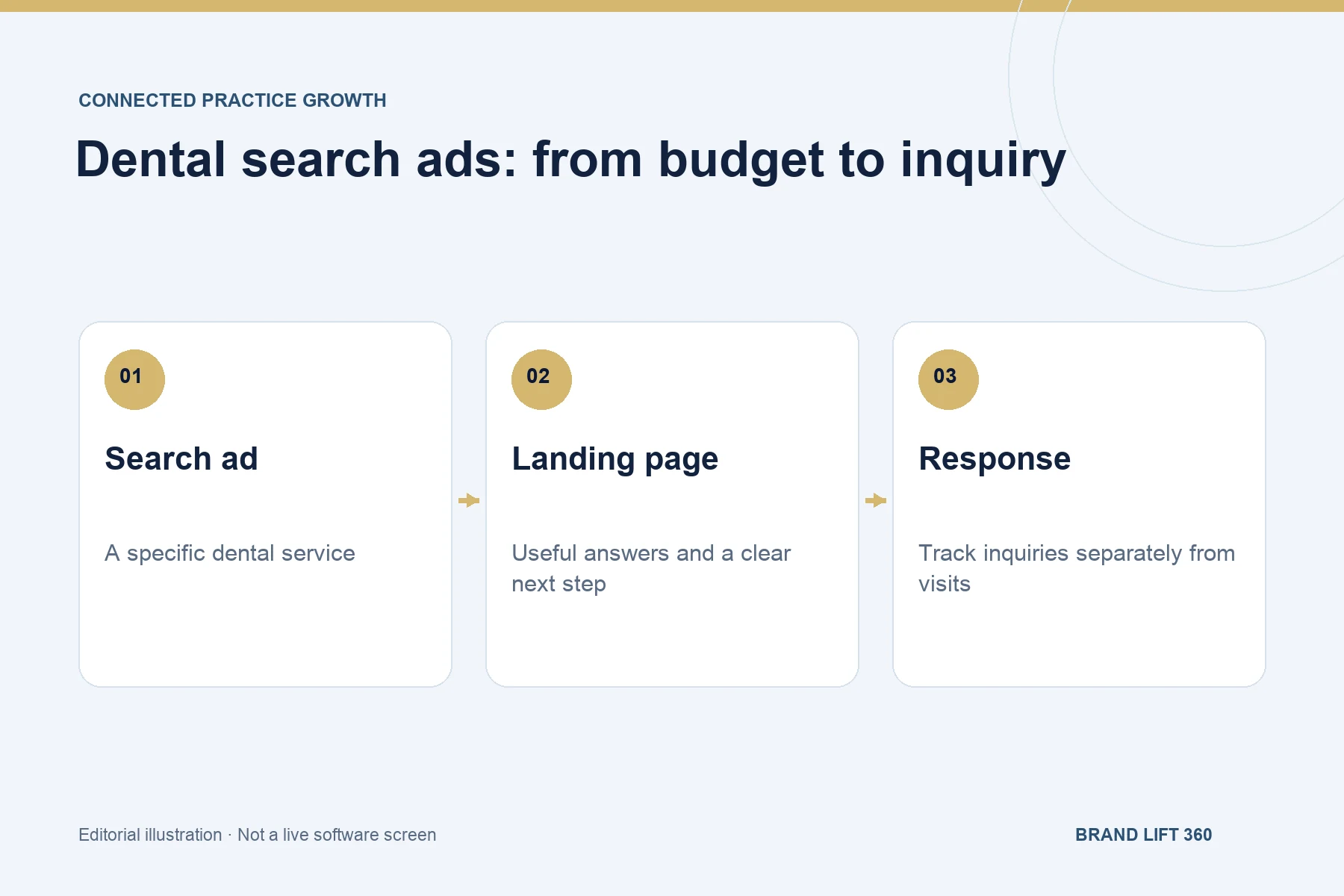
Google Ads for dentists works best as one campaign per service, starting with the services patients search by name and book quickly: emergency visits, new-patient exams, implants and aligners. In Sacramento, average clicks ranged from $9.28 for “invisalign” to $61.40 for “dental implants near me” (Google Ads data via DataForSEO, October 2025 to September 2026). We start at $1,500 a month per campaign, paid directly to Google, and our dental cost per lead is approximately $70. A lead is a call or form, not a booked visit, so judge every campaign by cost per booked appointment.
Brand Lift 360 runs Google Ads as part of our dental marketing for private practices in Roseville and Greater Sacramento. This guide is about building dental campaigns: which services to advertise, which keywords to bid on and block, how to budget and what to measure. For how Google bills you and click prices across other specialties, read How Much Does Google Ads Cost for a Medical Practice?
What Do Dental Clicks Cost in Sacramento?
Cost per click (CPC) is what Google charges each time someone clicks your ad. For dental searches in Sacramento, it depends mostly on the treatment:
| Service | Search (Sacramento) | Monthly searches | Average CPC | Top-of-page bid range |
|---|---|---|---|---|
| Aligners | invisalign | 1,300 | $9.28 | $1.42–$10.44 |
| Aligners | invisalign sacramento | 90 | $21.08 | $8.71–$22.55 |
| Whitening | teeth whitening sacramento | 140 | $12.74 | $1.70–$6.15 |
| New patients | dentist near me | 3,600 | $13.08 | $5.48–$24.00 |
| New patients | dentist that accepts medi-cal near me | 210 | $13.87 | $3.49–$12.37 |
| Orthodontics | orthodontist near me | 590 | $16.08 | $7.35–$25.75 |
| Emergency | emergency dentist sacramento | 480 | $17.42 | $5.00–$17.25 |
| New patients | dentist sacramento | 1,000 | $20.49 | $5.91–$18.01 |
| Pediatric | pediatric dentist near me | 260 | $22.25 | $4.77–$35.45 |
| Cosmetic | cosmetic dentist sacramento | 110 | $29.35 | $3.41–$42.27 |
| Implants | dental implants | 480 | $51.13 | $13.00–$58.41 |
| Implants | dental implants sacramento | 170 | $56.88 | $15.61–$60.00 |
| Implants | dental implants near me | 140 | $61.40 | $25.00–$79.60 |
Source: Google Ads Keyword Planner data, retrieved through DataForSEO on October 27, 2026; Sacramento, California city location, English; 12 months from October 2025 to September 2026. “Near me” searches and searches without a city were made from Sacramento. Google returned no estimate for “emergency dentist near me,” “root canal near me,” “wisdom teeth removal near me,” “dentures near me,” “veneers sacramento” or “sedation dentistry sacramento,” so they aren't shown.
Average CPC is what advertisers actually paid per click. The top-of-page bid range is Google's estimate of what advertisers bid to show above the regular results. The two are calculated differently, so an average can sit outside the range. Implant clicks averaged $51.13 to $61.40, against $9.28 to $29.35 for every other search in the table, which is why implants usually get their own campaign and their own budget.
Build One Campaign per Service
A campaign is one set of ads with its own budget. Splitting by service lets you see which service books and move money to it. Inside each campaign, keywords are the searches you choose to show your ad for, and each campaign sends clicks to the matching page on your website.
| Campaign | Example keywords | Landing page | Why it's separate |
|---|---|---|---|
| Emergency | emergency dentist sacramento, tooth pain dentist | An emergency page with same-day availability and a call button | Patients call right away; the phone has to be answered |
| New patients | dentist near me, dentist sacramento, family dentist near me | A new-patient page with insurance, first-visit steps and booking | Highest search volume; lower value per click |
| Implants | dental implants sacramento, dental implants near me | An implant page with the process, provider and a price range | Clicks cost $51 to $61, so it needs its own budget |
| Aligners | invisalign sacramento, clear aligners | An aligner page with consultation booking | Cheaper clicks, longer decision |
Start with one or two campaigns, not four. Pick the services you have chair time for and the highest value per booked patient.
Keywords to Bid On, and Keywords to Block
Bid on searches that name a service and a place, or say “near me.” Block the rest. A negative keyword tells Google not to show your ad when a search contains that word. Common negatives for a dental account include:
- Jobs and school: dental assistant jobs, hygienist salary, dental school.
- Do-it-yourself and products: at-home whitening kits, toothpaste, mouthguard to buy.
- Insurance you don't take: if you don't accept Medi-Cal, block “medi-cal.” If you do, “dentist that accepts medi-cal near me” drew about 210 searches a month in Sacramento, and it deserves its own ad group.
- Services you don't offer: block them by name, so an implant ad never shows for a service you refer out.
Check the location setting too. Google's default and recommended option is “Presence or Interest.” The narrower “Presence” option shows ads to people who are “likely to be located, or regularly located” in the places you target. For a local practice, Presence helps keep your budget on people who can actually get to your office. Then review the search terms report every week for the first 90 days: it shows what people actually typed before they clicked.
How Much Should a Dental Practice Budget for Google Ads?
We start ad budgets at $1,500 a month per campaign, paid directly to Google with no markup. That is our planning number for a dental practice, not a Google minimum. Here is roughly what it buys at Sacramento click prices:
| Campaign | Average CPC | Approximate clicks for $1,500 |
|---|---|---|
| invisalign | $9.28 | 161 |
| dentist near me | $13.08 | 114 |
| emergency dentist sacramento | $17.42 | 86 |
| pediatric dentist near me | $22.25 | 67 |
| cosmetic dentist sacramento | $29.35 | 51 |
| dental implants sacramento | $56.88 | 26 |
Clicks aren't patients. Cost per lead is ad spend divided by the calls and forms it produced. In our dental accounts it is approximately $70, which at $1,500 a month works out to roughly 21 calls and forms. Management is a separate line: Growth ($1,499 a month) manages up to $3,000 a month in ad spend, so two dental campaigns fit, and Authority ($2,999 a month) manages up to $10,000.
Cost per Lead vs. Cost per Booked Appointment
Cost per lead tells you what a phone call costs. Cost per booked appointment tells you what a patient in the chair costs, and it is the number that decides whether a campaign stays on. We track it for every client.
To measure it, count calls as well as forms. Google's call assets add a call button to your ad: “people can tap or click a button to call your business directly or go to your website,” and Google says “you can count calls as conversions by turning on call reporting.” A conversion is an action you count as a result, such as a call or a form. Then match each call to a booked appointment in your CRM, the software that tracks every inquiry from first call to booked visit.
The page and the follow-up decide the rest. On our dental marketing page we report two results: a dental client's share of Google Ads interactions that became leads rose from 3.61% to 7.36% (July to early October 2026), and an oral surgery client's rose from 1.83% to 8.99% (October 2025 to August 2026). Those are leads, not bookings. For the booking side, read Google Ads for Medical Practices: Connect Spend to Booking Outcomes.
Advertising Rules Dentists Should Know
Ad copy is advertising, and dental advertising has rules beyond Google's. The primary sources say it plainly:
- The ADA Code of Ethics, Section 5.F: “no dentist shall advertise or solicit patients in any form of communication” … “in a manner that is false or misleading in any material respect.” The ADA describes the test as whether the advertisement, “taken as a whole, is false or misleading in a material respect.”
- California Business and Professions Code section 651 makes it unlawful for licensees to disseminate a public communication with “a false, fraudulent, misleading, or deceptive statement, claim, or image.” It treats a fee claim as misleading when it “relates to fees, other than a standard consultation fee or a range of fees for specific types of services, without fully and specifically disclosing all variables and other material factors.”
- Specialty claims: the ADA notes that most states specifically regulate the advertising of dental specialties.
If an ad names a price, a specialty or a result, check it against the Dental Board of California's laws and regulations or with your attorney before it runs.
Google Ads for Dentists at a Glance
| Question | Answer |
|---|---|
| How to structure it | One campaign per service, each sending clicks to its own page |
| Sacramento click prices | $9.28 (invisalign) to $61.40 (dental implants near me) |
| Where to start | One or two services you have chair time for: emergency, new patients, implants or aligners |
| Starting budget | $1,500 a month per campaign, paid directly to Google, no markup |
| Our dental cost per lead | Approximately $70; a lead is a call or form, not a booked visit |
| What to judge it by | Cost per booked appointment |
| Rules | ADA Code Section 5.F; California Business and Professions Code section 651 |
Common Questions About Google Ads for Dentists
How much do Google Ads cost for a dentist?
You set the budget and pay per click. In Sacramento, average dental clicks ranged from $9.28 for “invisalign” to $61.40 for “dental implants near me” over the 12 months to September 2026. We start at $1,500 a month per campaign, paid directly to Google.
What is a good cost per lead for dental Google Ads?
In our dental accounts, cost per lead is approximately $70. A lead is a call or form, not a booked visit, so track cost per booked appointment as well. That is the number that shows whether the ads paid for themselves.
Can a dental ad show a new-patient special price?
California's Business and Professions Code section 651 treats a fee claim as misleading unless it is a standard consultation fee or a range of fees for specific types of services, or it fully and specifically discloses all variables and other material factors. Have the wording checked before the ad runs.
Do I pay the agency for my Google Ads clicks?
Not with us. You pay Google directly from your own ad account, with no markup. Ad management is included in our Growth and Authority managed marketing plans.
What to Do This Week
Pick the one dental service you most want more of and have room for. Search it with your city on your phone and note which practices advertise and where their ads lead. If you already run ads, open the search terms report for the last 30 days and count how many searches had nothing to do with that service. Those are your first negative keywords.
Sources
- Google Ads Keyword Planner data, retrieved through DataForSEO on October 27, 2026: monthly searches, average cost per click and top-of-page bid ranges, Sacramento, California city location, English, 12 months from October 2025 to September 2026.
- Google Ads Help, “About advanced location options”, accessed October 27, 2026. Source for the Presence and Presence or Interest settings.
- Google Ads Help, “About call assets”, accessed October 27, 2026. Source for call buttons and counting calls as conversions.
- American Dental Association, “Marketing and Advertising”, accessed October 27, 2026. Source for the Section 5.F quote, the “taken as a whole” test and specialty advertising.
- California Business and Professions Code section 651, subdivisions (a) and (b)(4), official text at California Legislative Information; part of the Business and Professions Code articles listed on the Dental Board of California's laws page. Wording checked October 27, 2026.
- Brand Lift 360 (our own data): dental cost per lead of approximately $70, from our clients' Google Ads accounts, where a lead is a tracked call or form, not a booked visit. Lead-rate results as published on our dental marketing page. The $1,500 starting budget is our planning recommendation.