
The short answer
Yes. Facebook and Instagram ads can book patients for a medical practice, mostly for elective and visual services that people don’t search for by name. Three limits apply. Meta’s terms bar advertisers from sending it health information. HHS says a tracking pixel on a page that handles patient information needs a business associate agreement. And Meta’s ad rules restrict health claims, wording about the viewer and some targeting. Run the ads on Meta, count booked appointments in your own system, and plan from $1,500 a month per campaign.
Brand Lift 360 runs Facebook, Instagram and Google ads for medical practices in Roseville and Greater Sacramento. Meta is the company that owns Facebook and Instagram, so “Meta ads” means paid posts in both apps’ feeds, Stories and Reels. This guide is general information, not legal advice. The rules below come from pages we read on November 12, 2026, and each one is named where it is used. Have your attorney or compliance lead review your own setup.
Do Facebook ads work for a medical practice?
They can, for the right services. Start with reach. Pew Research Center’s report Americans’ Social Media Use 2025 found that 71% of U.S. adults use Facebook and half use Instagram. Pew surveyed 5,022 adults from February 5 to June 18, 2025.
| Platform | U.S. adults who use it | Who uses it most |
|---|---|---|
| 71% | Adults 30 to 49, at 80% | |
| Half | Adults 18 to 29, at eight in ten; 19% of adults 65 and older; 55% of women and 44% of men |
Source: Pew Research Center, Americans’ Social Media Use 2025, published November 20, 2025.
Reach is not intent. Google shows an ad to someone who just typed “podiatrist near me.” Meta shows an ad to people in an area and age range you choose while they scroll. So Meta ads tend to work when four things are true:
- The service is elective or visual. Skin treatments, cosmetic dentistry and body contouring can be shown. A sore throat can’t wait for an ad.
- There is one clear next step. A consultation, a new-patient visit or an event, on a page built for that one service.
- Someone answers quickly. A person who filled out a form while scrolling was not planning to book today. Our guide to lead follow-up for medical practices covers response times.
- You can count what booked. Meta will report clicks and forms. Only your own records show appointments.
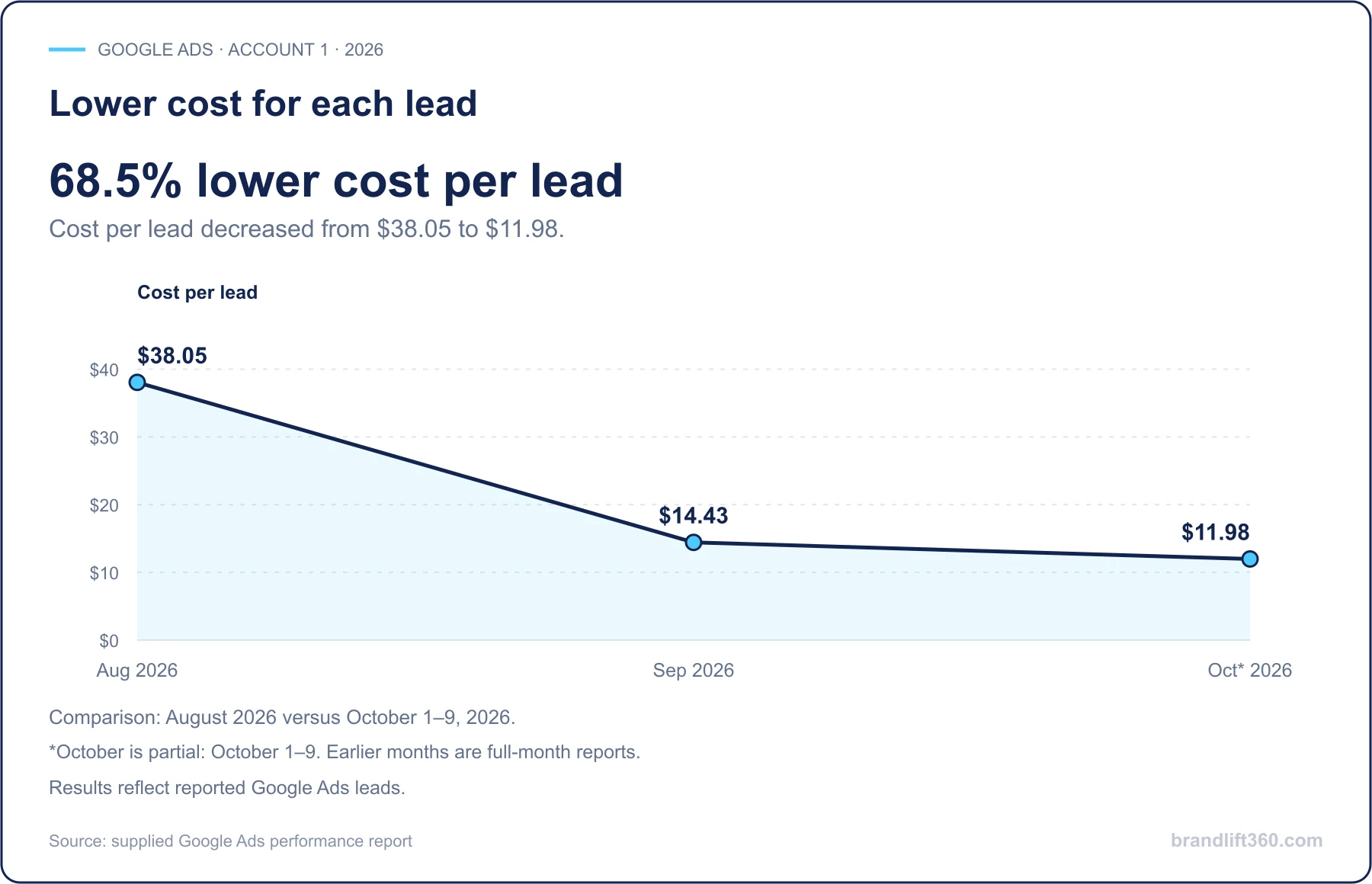
Two honest limits on the evidence. We have not found a neutral public benchmark for what a booked appointment from Meta ads should cost a medical practice, so this guide doesn’t quote one. And the ad results on our paid advertising page come from Google Ads accounts, such as a specialty practice whose cost per lead fell from $38.05 to $11.98. Those are leads, not booked appointments, and not Meta results, so we don’t use them to predict what Meta will do for you.
Can a practice use the Meta pixel and stay HIPAA compliant?
It depends on which page the pixel sits on and what it sends. For any page that handles patient information, the safe working answer is no. The Meta pixel is a snippet of code on your website that reports what visitors do back to Meta. HIPAA is the federal law that protects patients’ health information. Protected health information (PHI) is health information that identifies a person and relates to their health, their care or payment for care. HHS is the U.S. Department of Health and Human Services, which enforces HIPAA. A business associate agreement (BAA) is a contract in which a vendor that handles PHI for a practice agrees to protect it.
HHS covers pixels in its guidance, Use of Online Tracking Technologies by HIPAA Covered Entities and Business Associates. It lists “web beacons or tracking pixels” among tracking technologies and says practices covered by HIPAA “must ensure that all tracking technology vendors have signed a BAA” before PHI is disclosed to them. By page type:
| Page type | What HHS says | What to do with the Meta pixel |
|---|---|---|
| Patient portal and other logged-in pages | Tracking on user-authenticated pages “generally have access to PHI” | Keep it off |
| Public pages where people book, schedule or fill in intake details | Tracking on a page that lets people schedule appointments “may have access to PHI in certain circumstances” | Keep it off, including the thank-you page |
| Public treatment, condition and provider pages | Unsettled. A federal court vacated part of the guidance on June 20, 2024, and HHS says it “is evaluating its next steps” | Get counsel’s review before adding it |
| Careers, general practice information | Tracking on many unauthenticated pages does “not have access to individuals’ PHI” | Lower risk; still confirm what is sent |
The part the court set aside was HHS’s position that HIPAA applies when a tool connects a visitor’s IP address with a visit to a public page about specific health conditions or providers. Two workarounds don’t hold up either. HHS says website banners that ask visitors to accept tracking “do not constitute a valid HIPAA authorization.” It also says “it is insufficient for a tracking technology vendor to agree to remove PHI from the information it receives.”
Now Meta’s side. Meta’s Business Tools Terms, effective November 3, 2025, cover the Meta Pixel and the Conversions API, Meta’s tool for sending the same data from your server. In those terms the advertiser promises not to share data that “includes or is based on, directly or otherwise, health information.” The terms contain no BAA. Put the two sources together and the practical rule is simple: PHI should never reach Meta, by pixel or by server.
Meta also sorts websites into data source categories. Its Business Help Center says the health and wellness category covers sites associated with “provider/patient relationships.” For a restricted category, Meta may block URL details, restrict mid and lower funnel events (the actions closest to a booking), or stop event sharing entirely. It adds that its systems “are not a substitute for your own compliance mechanisms.”
What if your practice is not covered by HIPAA? Whether a cash-pay practice is covered depends on how it bills, so ask your attorney. Either way, the Federal Trade Commission (FTC), the federal consumer protection agency, is watching. On July 20, 2023, the FTC and HHS sent a joint letter to approximately 130 hospital systems and telehealth providers that named the “Meta/Facebook pixel and Google Analytics.” The FTC said unauthorized disclosure of personal health information by companies outside HIPAA “may violate the FTC Act.”
A careful setup usually looks like this:
- No Meta pixel on portal, booking, intake or thank-you pages.
- No names, emails, conditions or procedures in page addresses or event names.
- Any tag on treatment pages reviewed by counsel first.
- Booked appointments counted in your own system, not sent back to Meta.
For analytics and forms, see Is Google Analytics HIPAA Compliant? and our guide to HIPAA-compliant forms.
What does Meta not allow in health ads (before-and-after images, targeting limits)?
Meta publishes its ad rules in the Meta Transparency Center. Its Health and Wellness page shows a change log entry dated July 22, 2026, so check the live page before each campaign. These rules matter most for a medical practice.
| Rule | What Meta’s policy says | What it means for your ad |
|---|---|---|
| Age | Ads for cosmetic products, procedures or surgeries, and for weight loss, dietary or health products and services, must target people 18 or older | Set the age floor on every aesthetic and weight campaign |
| Wording about the viewer | Ads must not assert or imply personal attributes, including “physical or mental health (including medical conditions)” | “New diabetes treatment available” is Meta’s own allowed example. “Do you have diabetes?” is its not-allowed example |
| Appearance | No “statements of inferiority about physical appearance” | Describe the treatment. Don’t criticize a body part |
| Cure claims | No claims to cure, heal or eliminate 11 named conditions, including diabetes, cancer, psoriasis and Alzheimer’s. Claims about treating or managing symptoms are not covered by the ban | Say “treatment” or “management,” never “cure” |
| Exaggerated promises | No clickbait, such as “promises of specific outcomes within a set timeframe without disclaimers or qualifiers” | No “10 pounds in 10 days” |
| Lead forms | Lead ad questions must not request health information, “including physical health, mental health, medical treatments, medical conditions or disabilities,” without Meta’s prior permission | Ask for contact details only |
Before-and-after images. Meta’s Health and Wellness policy allows ads for “general cosmetic products, procedures, surgeries depicting before and after transformation” when they target adults 18 and older. Its list of permitted cosmetic procedures names 16, from rhinoplasty to dermal fillers, chemical peels and micro-needling.
California adds its own rule. The state’s Business and Professions Code section 651, an advertising law for licensed health professionals, names the Internet as a covered channel. For before-and-after views of a patient, it requires the ad to say what procedures were performed, to keep the two views “comparable in presentation,” and to state that the same results “may not occur for all patients.” A photo of anyone who is not your actual patient must be labeled as a model. That applies to a Roseville or Sacramento practice whatever Meta allows.
Targeting limits. Two matter most:
- Audiences built from health information. A custom audience is a list of people you ask Meta to show ads to, such as past website visitors, and a lookalike audience is a group Meta builds to resemble one. Meta says audiences that reference specific health conditions, “e.g., arthritis,” are flagged and can’t be used.
- Retargeting. Retargeting means showing ads to people who already visited your website. It depends on the pixel and on your site’s data source category, so it may be limited or unavailable for a practice. Confirm it for each campaign.
Prescription drugs. Meta’s Drugs and Pharmaceuticals policy says online pharmacies and telehealth providers that promote prescription drugs must be certified with LegitScript, a third-party certification company, and authorized by Meta. Ads that “promote telehealth services generally” don’t need that authorization. If an ad promotes a prescription weight-loss medication, ask Meta how the policy applies before you launch. Meta makes the final call on every ad.
Which treatments suit Meta ads and which suit Google Ads?
Google Ads are paid listings that appear when someone types a search. Our usual starting point: when people search for a service by name, Google comes first. When they discover it while scrolling, Facebook and Instagram often do better. Many practices end up running both.
| Service | How patients usually find it | Start on | Watch for |
|---|---|---|---|
| Urgent or same-day care | Searching on a phone, right now | Calls must be answered | |
| Services searched by name with a city, such as dental implants or a podiatrist | Typing the service and the place | Google, then Meta | Each service needs its own page |
| Visual, elective treatments, such as skin treatments, body contouring and cosmetic dentistry | Seeing a result or an offer while scrolling | Meta | Meta’s 18 and older rule and appearance wording |
| Memberships, seasonal offers, events, a new provider or location | They don’t search for these | Meta | An exact offer and an end date |
| Sensitive care, such as mental health or weight management | Searching privately | Google first, Meta with care | Never imply the viewer has a condition |
| Prescription medication | Searching by drug name | Check policy first | Meta requires certification and authorization; Google restricts prescription drug terms |
Google has its own health limits. Its Health in personalized advertising policy treats health as a sensitive interest category, and Customer Match (uploaded patient or lead lists), your data segments (past site visitors), audience expansion and lookalike segments are not supported for ads in those categories. Its Healthcare and medicines policy says Google “restricts the use of prescription drug terms in ads, landing pages, and keywords.”
For one specialty at a time, read our guides to med spa advertising on Google and Meta, dental advertising, plastic surgery advertising, chiropractic advertising and therapist advertising. For the search side, see Google Ads for medical practices and what Google Ads costs in Sacramento.
How should a practice track booked appointments from Meta leads?
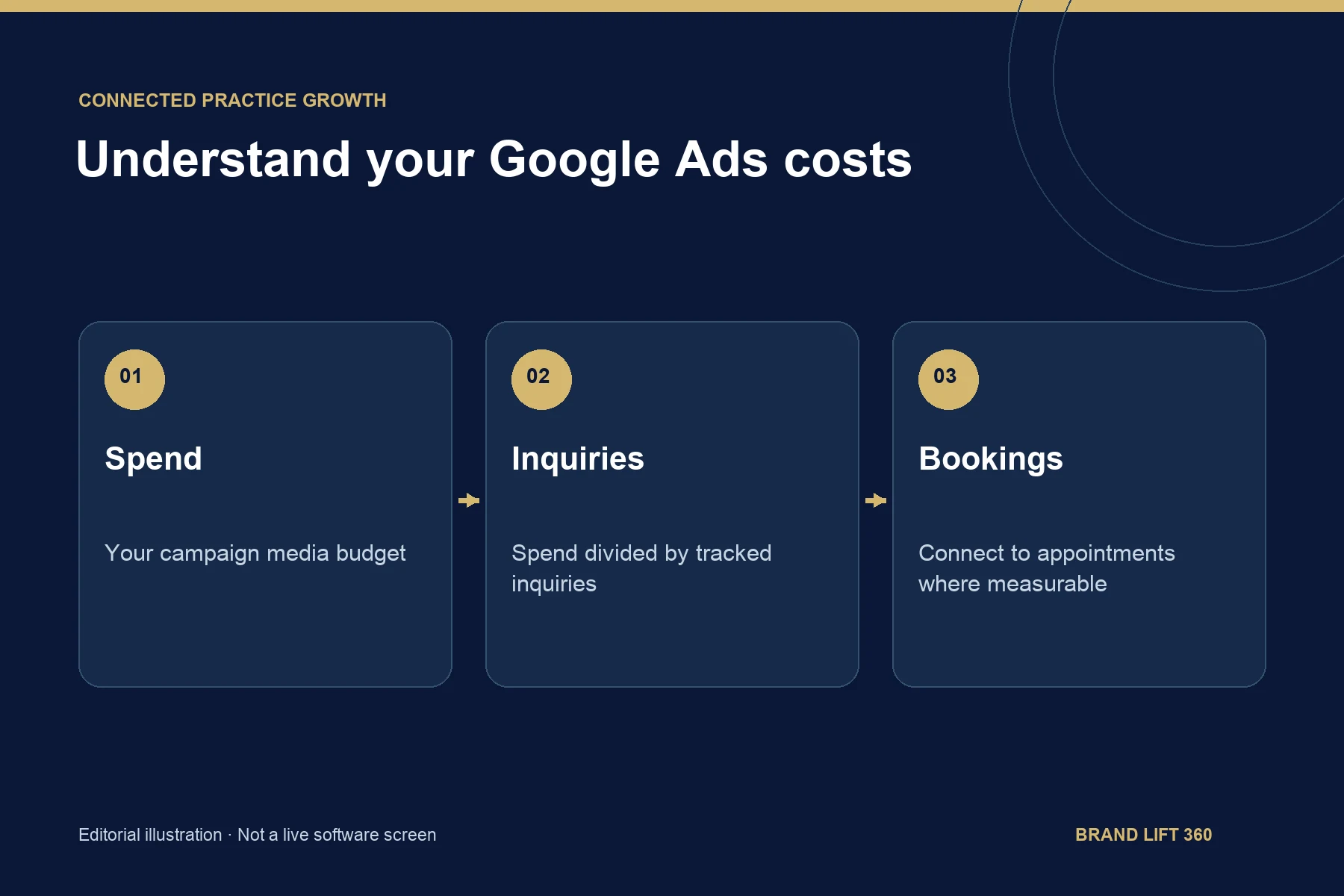
Keep three words apart. An inquiry is any call, form or message. A lead is an inquiry from a real potential patient for a service you offer. A booked appointment is a visit on your schedule. Meta’s dashboard stops at the form. The number that matters is the booked appointment, and it lives in your records.
A way to count it without sending patient data to Meta:
- Tag the source before the click. A UTM tag is a short label added to the end of an ad’s link that tells your website which campaign sent the visitor. Use one per campaign.
- Use one form per campaign. Meta’s rules don’t let a lead form ask about health without permission, so ask for name, phone and email only. If each campaign has its own form, you already know which service the person wants.
- Give ads their own phone number. Call tracking means a dedicated number that shows which ad or page produced a call.
- Put every inquiry in one place. A CRM (customer relationship management system) is software that tracks each inquiry from first contact to booked visit. Both of our managed marketing plans include a healthcare CRM.
- Match inquiries to the schedule weekly. Mark each one as booked, not booked or not a fit.
- Keep the outcome in-house. A booking report inside your practice is different from a booking event sent to an ad platform. Review any data sharing against the HHS guidance and Meta’s terms first.
Here is the math with example numbers, not a forecast. Say one campaign spends $1,500 in a month and brings 40 inquiries. Of those, 25 are leads and 8 book.
| Measure | Example count | Cost at $1,500 spend |
|---|---|---|
| Inquiries | 40 | $37.50 each |
| Leads | 25 | $60 each |
| Booked appointments | 8 | $187.50 each |
The first row is what an ad dashboard shows. The last row is what you compare with the value of a new patient. If quicker follow-up turns 8 bookings into 12, the cost falls to $125 each without spending more.
How much should a practice budget for Meta ads?
We start ad budgets from $1,500 a month per campaign, paid directly to Google or Meta with no markup. A campaign is one set of ads with its own budget, usually built around one service. That figure is our planning number, not a Meta minimum, and it is about $50 a day.
Meta’s own guidance explains why spreading a budget thin hurts. Its help page on the learning phase, the period when Meta’s delivery system is still learning who responds to an ad set, says ad sets usually leave that phase “after about 50 results in the week after the ad set’s last significant edit.” An ad set is a group of ads inside a campaign that shares one audience and budget. Meta’s advice on the same page is to “use realistic budgets” and to “avoid high ad volumes.”
Do the arithmetic. $1,500 a month is about $350 a week. Fifty results on $350 means each result would need to cost about $7. If your inquiries cost more than that, the ad set may show “Learning limited.” That is a reason to keep one campaign in one ad set and to edit it rarely, not a reason to quit.
| Setup | Plan fee | Ad spend, paid to the platform | Monthly total |
|---|---|---|---|
| Growth, one Meta campaign | $1,499 | $1,500 | $2,999 |
| Growth, one Google and one Meta campaign | $1,499 | $3,000 | $4,499 |
| Authority, two campaigns | $2,999 | $3,000 | $5,999 |
Both Growth and Authority include Google and Meta ads. Growth manages up to $3,000 a month in ad spend and Authority up to $10,000. To judge any of these totals, divide the monthly total by what one booked patient is worth to your practice. That tells you how many booked appointments cover the cost. Then review results every month, and at day 90 decide whether to shift the budget. Full details are on our plans and pricing page.
Common Questions About Facebook and Instagram Ads for Doctors
Are Facebook ads HIPAA compliant for doctors?
Running a Facebook or Instagram ad does not involve patient data, so the ad itself is not the HIPAA question. The risk is in what your website sends back to Meta. HHS guidance on online tracking technologies says tracking tools on patient portals and on pages where people schedule appointments can involve protected health information. This is general information, not legal advice.
Will Meta sign a business associate agreement?
Meta’s published Business Tools Terms, effective November 3, 2025, contain no business associate agreement. Instead, they require advertisers to promise not to share data that includes or is based on health information. The practical approach is to treat Meta as a company that should never receive protected health information, and to ask your attorney if your case differs.
Can doctors use before-and-after photos in Facebook and Instagram ads?
Often, yes. Meta’s Health and Wellness policy allows ads for cosmetic procedures that show a before-and-after transformation when they target adults 18 and older, and it bans statements of inferiority about appearance. In California, Business and Professions Code section 651 also requires the ad to name the procedures performed and to state that the same results may not occur for all patients.
Can a medical practice retarget website visitors on Facebook?
Sometimes. Retargeting relies on the Meta pixel, and Meta’s Business Help Center says websites in its health and wellness category may have event sharing limited or fully restricted. Meta also flags audiences that reference specific health conditions. Confirm what your site is allowed to share, and have counsel review it, before building a retargeting campaign.
How much do Facebook ads cost for a medical practice?
Meta has no fixed price list. Meta’s Business Help Center says an auction takes place whenever someone is eligible to see an ad, so you set a budget and the price varies. Brand Lift 360 plans ad budgets from $1,500 a month per campaign, paid directly to Meta with no markup. That is a planning number, not a Meta minimum or a promise of results. Judge the spend by cost per booked appointment.
Are Facebook ads or Google Ads better for doctors?
Neither is better for every service. Google Ads reach people who are searching for a service by name right now, which suits urgent care and named treatments. Facebook and Instagram ads reach people who are not searching, which suits elective and visual services, offers and announcements. Many medical practices run both.
What to Do This Week
Ask whoever manages your website for a written list of every page the Meta pixel loads on. If your booking page, intake form, portal or thank-you page is on it, have the pixel removed from those pages and send the list to your attorney. Next, read your current ad for one elective service: no question about the viewer’s health, no criticism of appearance, no cure claim, age set to 18 and older where required. Last, count last month’s booked appointments that began with a Facebook or Instagram inquiry. If you can’t get that number, fix tracking before you raise the budget.
Sources
- U.S. Department of Health and Human Services, Office for Civil Rights, Use of Online Tracking Technologies by HIPAA Covered Entities and Business Associates, content last reviewed June 26, 2024, accessed November 12, 2026. Source for tracking pixels, page types, the BAA requirement, website banners, vendor promises to remove PHI and the June 20, 2024 court order.
- Meta, Meta Business Tools Terms, effective November 3, 2025, accessed November 12, 2026. Source for the tools covered and the health information clause.
- Meta Business Help Center, About data source categories in Meta Events Manager and Understand data sharing restrictions based on data source categories, accessed November 12, 2026. Source for the health and wellness category and the three types of restriction.
- Meta Transparency Center, Health and Wellness advertising standard, change log entry July 22, 2026, accessed November 12, 2026. Source for age targeting, appearance wording, cure claims, clickbait, permitted cosmetic procedures and before-and-after transformation.
- Meta Transparency Center, Privacy Violations and Personal Attributes advertising standard, accessed November 12, 2026. Source for the personal attributes rule and the diabetes examples.
- Meta Transparency Center, Introduction to the Advertising Standards, Lead Ads section, accessed November 12, 2026. Source for the limit on health questions in lead forms.
- Meta Transparency Center, Drugs and Pharmaceuticals advertising standard, accessed November 12, 2026. Source for the prescription drug certification and authorization rules.
- Meta Business Help Center, Understand restrictions on certain custom audiences, About the learning phase and About ad auctions, accessed November 12, 2026. Source for flagged audiences, the 50 results figure and the ad auction.
- Federal Trade Commission, FTC and HHS Warn Hospital Systems and Telehealth Providers about Privacy and Security Risks from Online Tracking Technologies, July 20, 2023, accessed November 12, 2026.
- Pew Research Center, Americans’ Social Media Use 2025, November 20, 2025, accessed November 12, 2026. Survey of 5,022 U.S. adults, February 5 to June 18, 2025.
- California Legislative Information, Business and Professions Code section 651, as amended by Stats. 2017, Ch. 775 (SB 798), effective January 1, 2018, accessed November 12, 2026.
- Google Advertising Policies Help, Health in personalized advertising and Healthcare and medicines, accessed November 12, 2026.
- Brand Lift 360 (our own data): Paid Advertising for Medical Practices, accessed November 12, 2026. Source for the $1,500 planning budget, plan prices, managed ad spend limits and the specialty practice’s Google Ads cost per lead. Practice names withheld. The 40, 25 and 8 figures in the tracking example are illustrative, not client data.