

The short answer
A practice blog post has one job: turn a patient's question into a booked consultation. The posts that do it are not longer or louder than the ones that fail. They are built differently, in a structure a patient can finish on a phone and an AI assistant can quote whole.
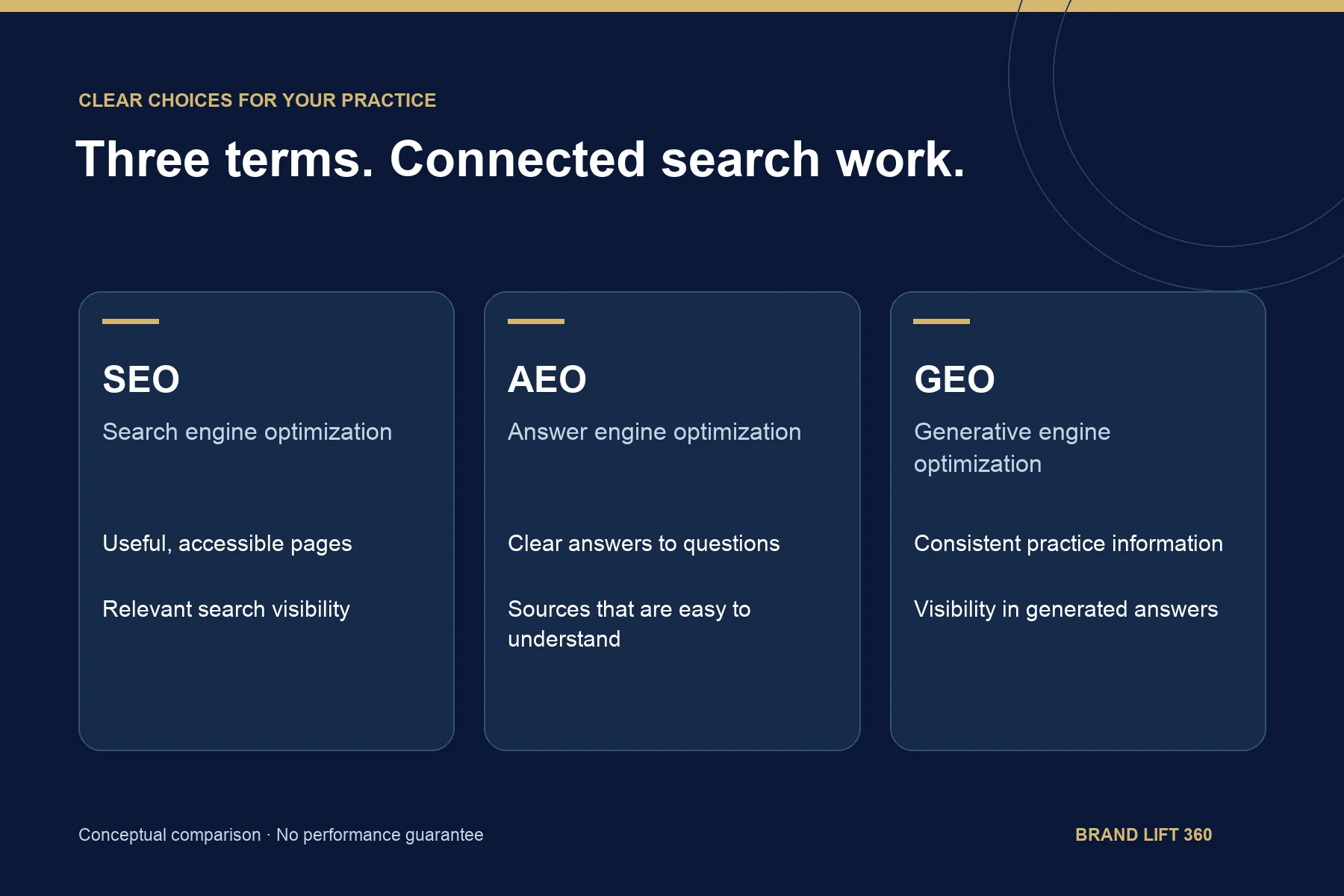
Most practice blogs fail quietly. The writing is fine, the design is fine, and nobody books, because the post was built to fill a content calendar instead of to answer a person. The standard below is the one behind our AI search visibility work for medical practices, also called AEO (answer engine optimization, the work of getting a practice named and cited in AI answers). It is the standard every Brand Lift 360 post now runs on. Ten parts. Each one earns its place.
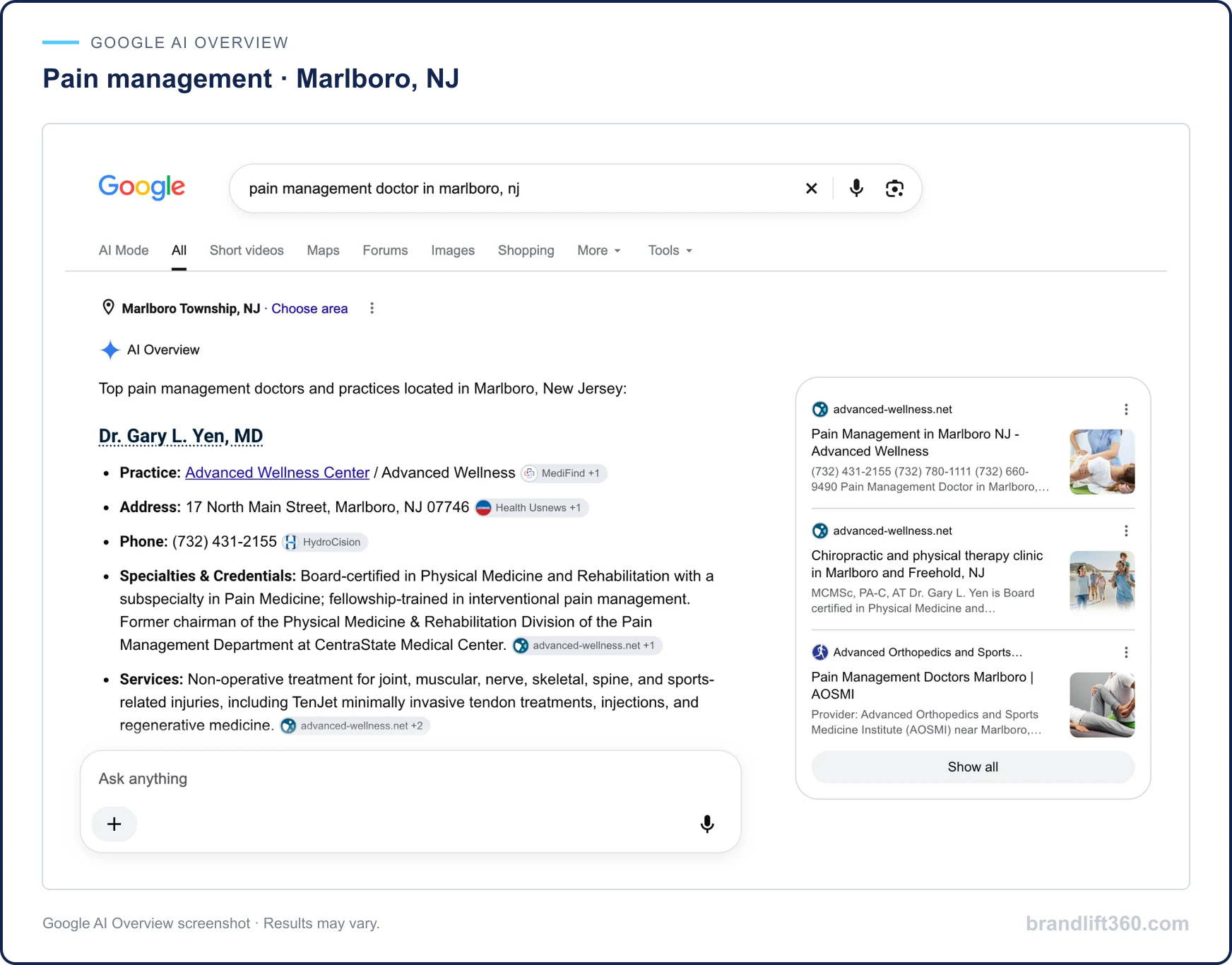
By AI assistants we mean tools such as ChatGPT, Gemini, Claude and Perplexity, along with AI Overviews, the answers Google's AI writes above its regular search results.
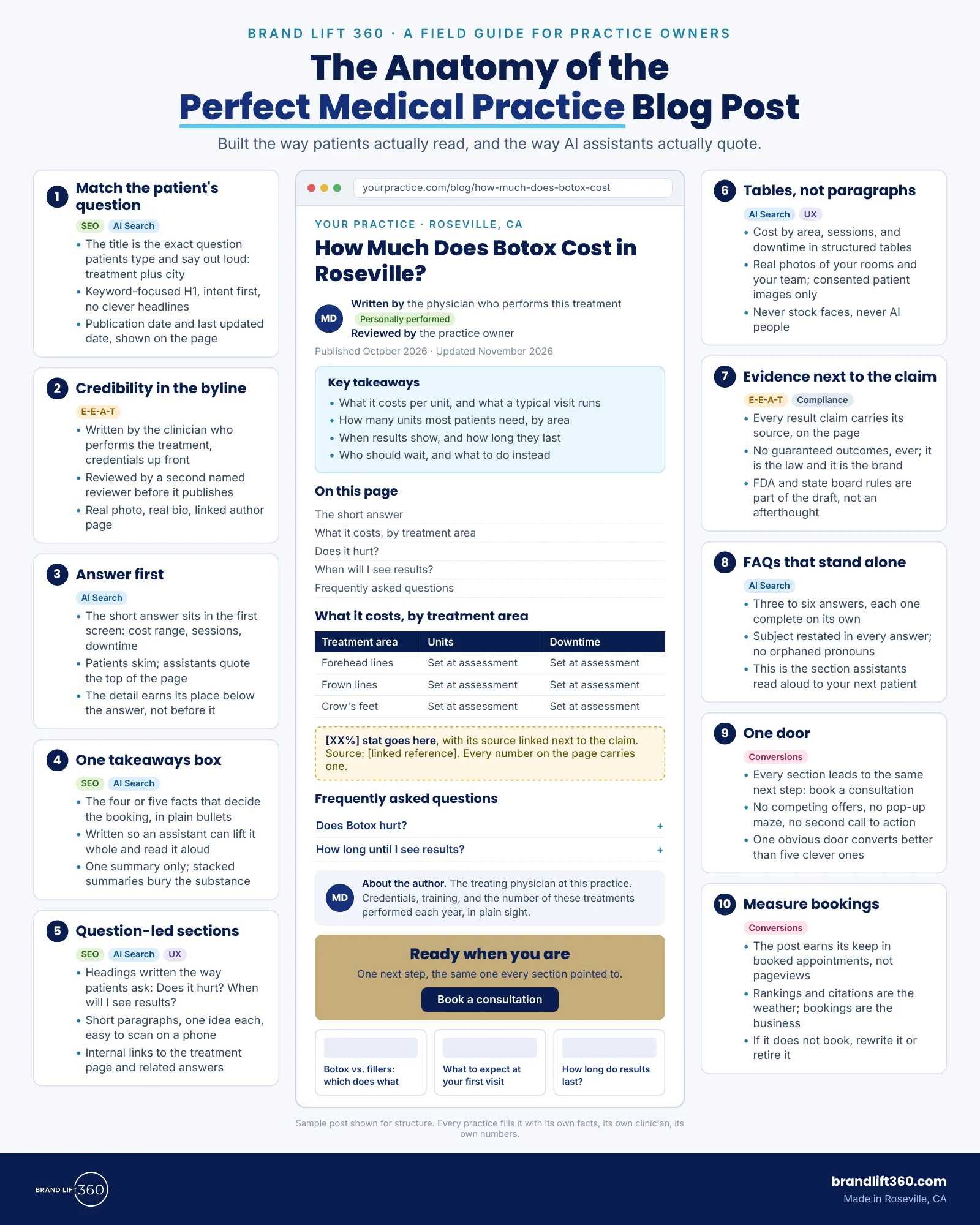
The standard in one paragraph: Title the post with the patient's exact question. Put the answer in the first screen. Credit the clinician who performs the treatment, and name the reviewer who checked it. Carry every claim with its source. Build the middle from questions, tables, and real photographs. End at one door: the consultation booking. Measure the post by appointments, not pageviews.
What Question Is the Patient Actually Asking?
Patients do not search the way marketers write. A patient asks a question, usually out loud, usually with money or fear attached to it. How much does Botox cost in Roseville? Does this treatment hurt? How long until I see results? Am I even a candidate?
That question is the title. Treatment plus city plus the real worry, in the words the patient used. A clever headline costs you the match, because the assistant answering that patient is looking for the page that answers the question as asked. AI search engines also expand one question into a family of related sub-questions before they answer, which is why a post built on the real question tends to inherit the whole family, and a post built on a keyword tends to inherit none of it.
Put two dates on the page and keep them honest: when the post was published, and when it was last updated. Patients read freshness as care. Assistants read it as a reason to trust the numbers on the page over a competitor's undated ones.
This article covers the post itself. For the site-level fixes that let assistants read your pages in the first place, see AI search optimization for medical websites.
Who Should Write the Post, and Who Should Review It?
The byline is a clinical credential, not a marketing credit. The strongest author for a treatment post is the clinician who performs the treatment, with their credentials in the byline, a real photograph, and an author page that says what they do and how often they do it. First-hand experience is the one asset a content farm cannot copy, and it is the asset patients and assistants both weight first.
A second named person reviews the post before it publishes. The reviewer checks the medicine, the claims, and the promises, and their name goes on the page next to the author's. “Written by” and “reviewed by” are two different trust signals, and a practice that shows both is showing its work.
If your clinician cannot write, interview them. Thirty minutes of their spoken answers, drafted into shape and reviewed by them before it ships, beats a polished post written by someone who has never stood in the treatment room. Anonymous bylines and stock author pages tell the reader, human or machine, that nobody at the practice stands behind the page.
Why the Answer Comes First
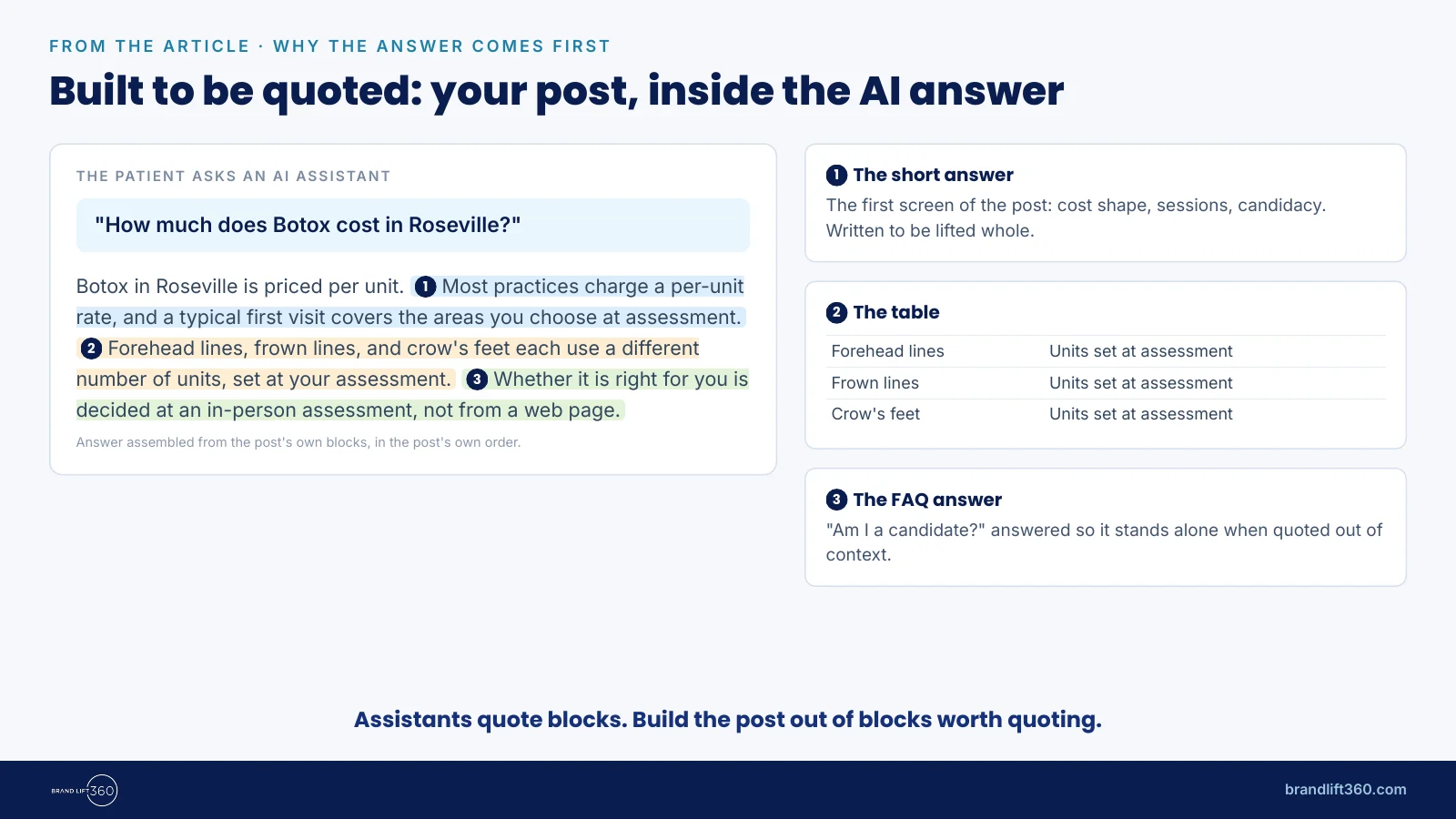
Patients skim. Assistants quote the top of the page. So the top of the page carries the answer: the cost range, how many sessions, what the downtime looks like, and who should wait. Everything after that is support for a decision the reader is already making.
One summary device does this job: a short answer at the top, or a key takeaways box, never both stacked with a table of contents and an at-a-glance grid in front of the substance. Four summaries before the first real sentence is how a post tells an assistant there is nothing underneath worth quoting.
There is evidence behind the order. In the best-known controlled test of what makes pages visible inside AI answers (Aggarwal and colleagues, Princeton and IIT Delhi, presented at KDD 2024), pages rewritten to add statistics, quotations from credible sources, and citations earned roughly 30 to 40 percent more visibility inside the answers than the originals, while keyword stuffing made pages less visible. Treat that as a benchmark result from a laboratory setup, not a promise about your post; later tests on newer models have been less generous. The direction, though, has survived every measurement since, including ours: evidence travels, decoration does not.
The Middle: Questions, Tables, and Real Photographs
Structure the body the way the questions arrive. Section headings written as patient questions (Does it hurt? When will I see results? What does recovery look like?) do double duty: a skimming patient finds their worry in two seconds, and an assistant lifting a section gets a complete question with its answer attached.
Anything with a number in it belongs in a table, not a paragraph. Cost by treatment area, sessions, downtime: a table is the format an assistant can read back accurately and a patient can compare without rereading. A model treatment table looks like this, with the practice's own facts in the cells:
| Treatment area | What the patient asks | Where the answer lives |
|---|---|---|
| Forehead lines | What will it cost me? | Price range and typical units, in the table |
| Frown lines | How long does it take? | Session length and visit count, in the table |
| Crow's feet | What is the downtime? | Recovery expectations, in the table, no promises |
Photographs follow the same rule as the byline: real or nothing. Your rooms, your team, your equipment, and patient images only with written consent on file. Never stock faces, and never AI-generated people, anywhere on the page. A practice selling trust cannot illustrate itself with people who do not exist.
The ten parts, at a glance:
| Part | What it does | Who it convinces |
|---|---|---|
| The patient's question as title | Matches the search and the spoken question | The patient, and the assistant matching pages to questions |
| Clinician byline, named reviewer | Puts credentials and accountability on the page | Both; it is the first trust check |
| Answer first, one summary | Delivers the decision facts in the first screen | The skimming patient; the quoting assistant |
| Question-led sections | Mirrors how worries actually arrive | The patient scanning for their concern |
| Tables for numbers | Makes cost, sessions, and downtime liftable | The assistant reading facts back |
| Real photographs | Proves the practice exists as described | The patient deciding whether to trust you |
| Evidence next to claims | Attaches a source to every result claim | The assistant checking whether to repeat you |
| Standalone FAQs | Answers that survive being quoted alone | The assistant reading an answer aloud |
| One door | Ends every path at the consultation booking | The patient who is ready |
| Measurement by bookings | Judges the post by appointments | Your practice, at the end of the month |
What Makes a Claim Safe to Print?
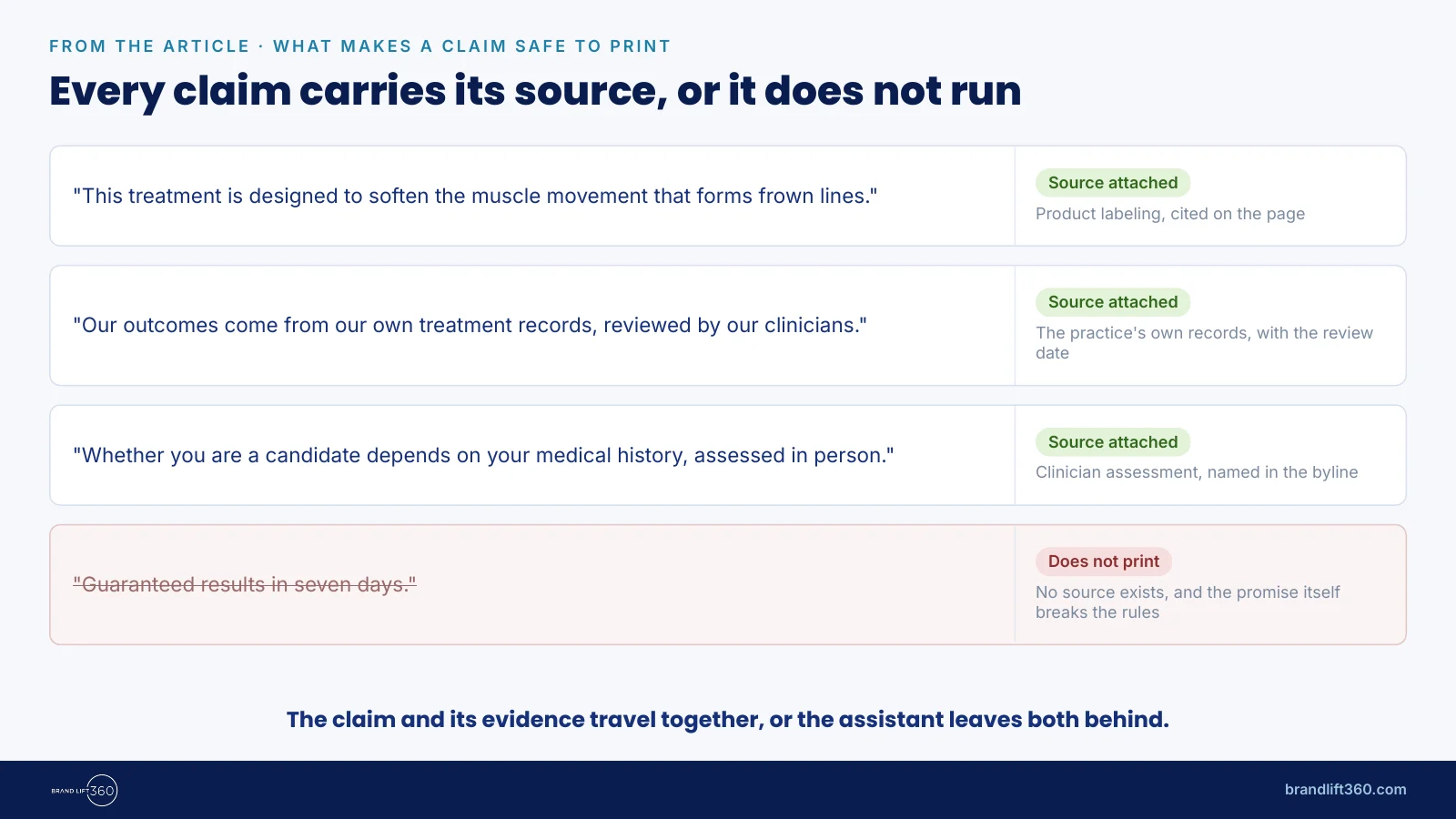
Every result claim on the page carries its source, on the page, next to the claim. Not a footnote dump at the bottom: the claim and its evidence travel together, because an assistant quoting the claim will leave the footnote behind.
No guaranteed outcomes, ever. It is a legal line before it is a style preference: medical advertising rules at the federal and state level, licensing board rules, and platform policies all restrict outcome promises, and a blog post is advertising. Write what a treatment is designed to do, what your own recorded outcomes show with their sources attached, and what determines whether a given patient is a candidate. The word “guarantee” and its cousins stay out.
Patient stories and before-and-after images need written consent, and a public reply to a review never confirms that the reviewer is your patient. These are not fine-print concerns. They are the difference between a post that builds the practice and a post that becomes a compliance file.
FAQs That Stand Alone
Close the body with three to six frequently asked questions, and write each answer to stand alone: the subject restated in the answer, no pronouns pointing back at text the reader may never see. Assistants lift FAQ answers out of context and read them aloud to your next patient. An answer that only makes sense inside your page fails at exactly the moment it gets used.
Keep the questions real. Pull them from your front desk, your consultation notes, and the calls your team fields every week. If patients are not asking it, it does not belong in the FAQ, no matter how well it would rank.
One Door at the End
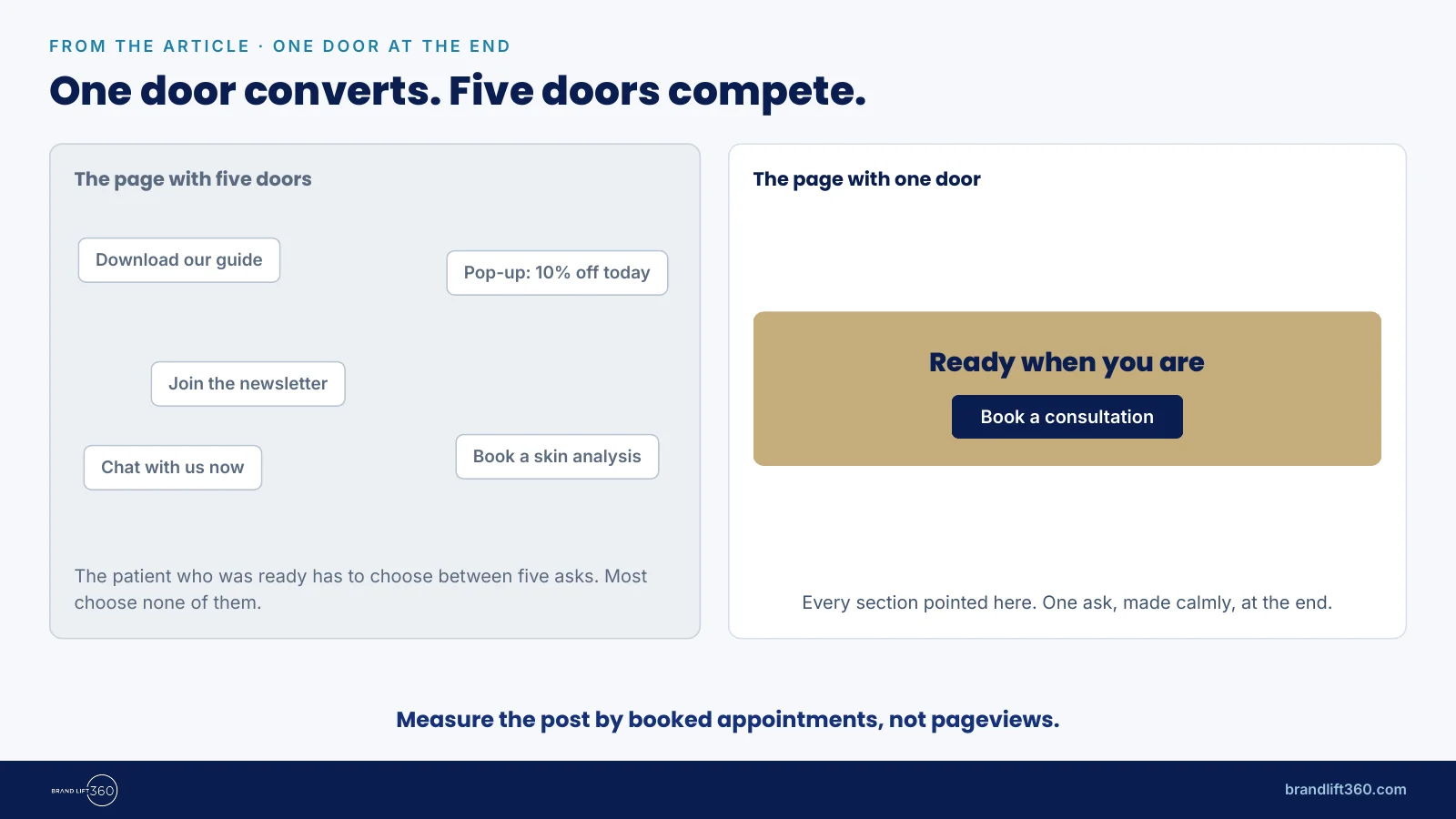
A practice post gets one call to action: book a consultation. Links inside the post are navigation, pointing to the treatment page, the author's page, and related answers. The ask is singular.
Five competing offers, a pop-up, a discount banner, and a chat widget all asking at once do not raise the chance a ready patient books. They raise the chance she leaves. One obvious door, repeated calmly at the end, converts better than five clever ones, and it keeps the post honest: the reader always knows what the page wants and can decline it cleanly.
What Should You Measure?
Booked appointments. Not pageviews, not time on page, and not even citations by themselves. Rankings and citations are weather: worth watching, useful for diagnosis, and not the crop. The crop is a patient who read the post, or heard it quoted by an assistant, and booked.
Judge each post at the end of the month. A post that books earns a refresh: new dates, new evidence, the questions your front desk heard this month. A post that does not book gets rewritten around the real question or retired. A small library of posts that book beats a large library of posts that merely exist, and it is cheaper to maintain.
Common Questions About Medical Practice Blog Posts
How long should a practice blog post be?
A practice blog post should be as long as the patient's question requires, and not a paragraph longer. A cost question with a table, candidacy notes, and FAQs usually lands between 1,200 and 2,000 words. Length is an outcome of covering the question completely, never a target to hit.
Our clinician cannot write. Who should be the author?
The clinician stays the named author. Interview the clinician for thirty minutes, draft from their answers, and have them review and approve the final text before it publishes, with the reviewer named on the page. The byline must be true: a writer shapes the words, and the medicine and the judgment are the clinician's.
Do AI assistants really quote practice blog posts?
AI assistants quote pages that answer a question cleanly, with evidence attached and a named human behind them. In Brand Lift 360's own measurement work, assistant answers about local practices are assembled from directories, review platforms, and pages like these, which is why the structure matters: a post built to be quoted is a post an assistant can use. A post built to fill a calendar gives an assistant nothing to lift.
How often should a practice publish?
Consistency beats volume. One strong practice blog post a month, built to this standard and measured, will outperform four thin posts written to a schedule. Publish when you have a real patient question to answer and a clinician's thirty minutes to answer it with.
Sources
- Aggarwal, P., et al. GEO: Generative Engine Optimization. Proceedings of KDD 2024 (arXiv:2311.09735). The controlled benchmark behind the visibility figures quoted above: statistics, quotations, and cited sources raised a page's visibility inside AI answers; keyword stuffing reduced it.
- SISTRIX. Citation Worthiness study. Structural analysis of 48,527 pages cited by AI systems; the evidence base for how citable pages are built.
- Brand Lift 360. AI Visibility Methodology. Our measurement method and published baselines, including the October 12, 2026 wave quoted in this post.
Written by Danzell Nunsuch, Co-founder, Chief Strategy & Innovation Officer. Researched and verified November 3, 2026.