
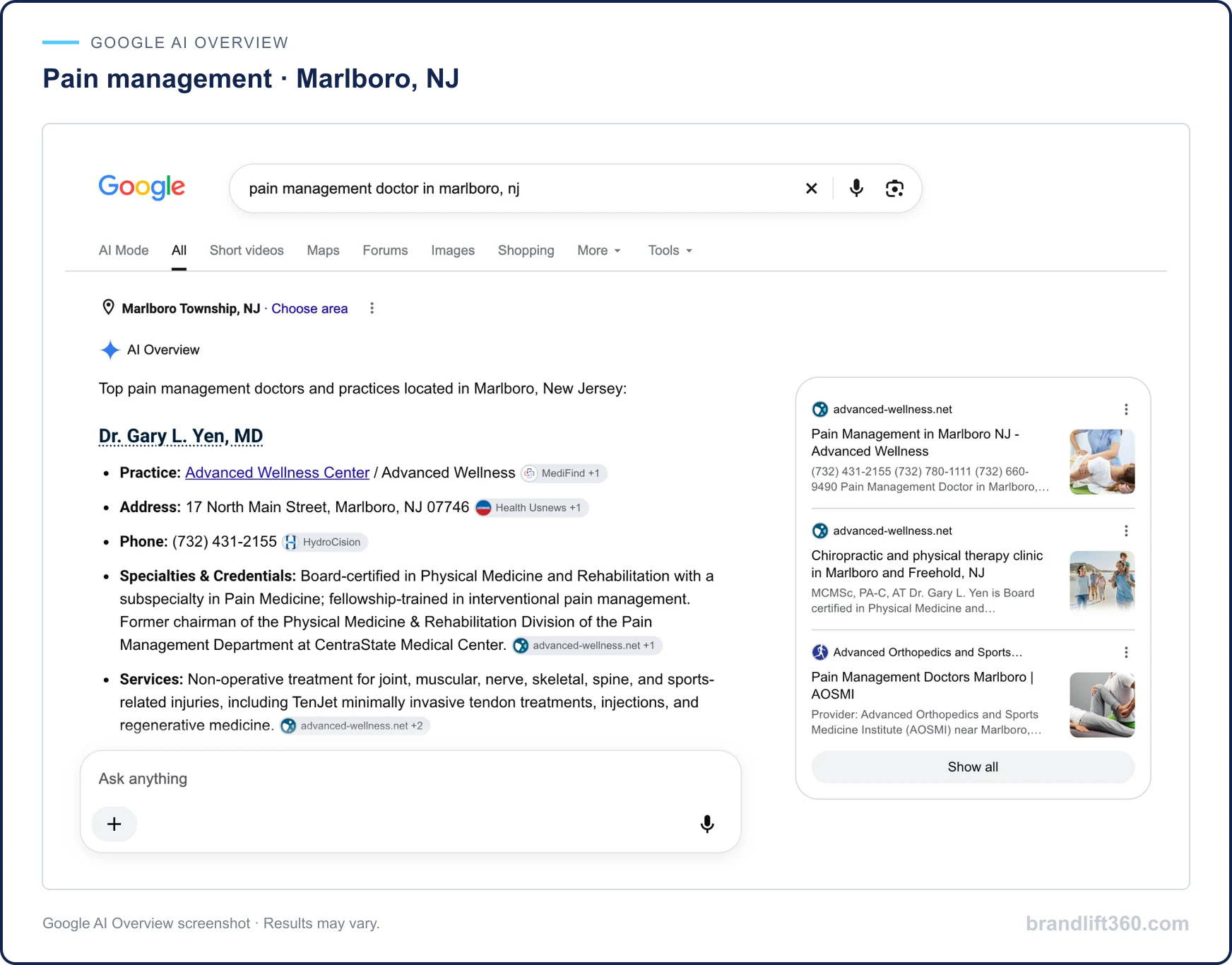
Google AI Overviews do take clicks: in a Pew Research Center study, people clicked a regular search result on 8% of visits when an AI summary appeared, compared with 15% when none did. Medical practices can still win local patients, because someone looking for care nearby still needs a map listing, a profile and a way to book. Keep your Google Business Profile accurate, make each service page answer the patient's question in its first two sentences, earn honest reviews, and measure calls and bookings, not clicks alone.
AI Overviews are the AI-written summaries Google shows at the top of some search results. AI Mode is Google's chat-style search. A Google Business Profile is the free listing that shows a practice in Google Search and Maps. AEO (answer engine optimization) is the practice of making your pages easy for those summaries, and for assistants like ChatGPT, to understand and quote. For the step-by-step on getting cited, read how to show up in Google AI Overviews. This article is about what the lost clicks mean for a local practice.
How Many Clicks Do AI Overviews Take?
The clearest independent numbers come from Pew Research Center, which analyzed the real Google searches of 900 U.S. adults during March 2025.
| What Pew measured | With an AI summary | Without an AI summary |
|---|---|---|
| Visits with a click on a regular search result | 8% | 15% |
| Visits where the person ended their browsing session | 26% | 16% |
| Visits with a click on a link inside the summary | 1% | Not applicable |
AI summaries appeared on 18% of the searches Pew studied. They showed up far more often on longer searches: 53% of searches with ten or more words, and 60% of searches that began with a question word. Short searches of one or two words triggered a summary only 8% of the time.
Google tells a different story. Liz Reid, head of Google Search, wrote in August 2025 that total organic clicks from Google to websites have been "relatively stable year-over-year." Google's developer guidance says clicks from results with AI Overviews are higher quality, meaning people are more likely to spend more time on the site. Google has not published the data behind either statement, so treat them as Google's position rather than an independent measurement.
For a medical practice, the clicks most at risk are long, informational questions, such as what a treatment involves or how long recovery takes. A patient searching for a dentist or med spa near them is usually shown map results, reviews and booking links, and that is where a practice wins or loses the visit. Our guide on how to rank higher on Google Maps covers that side in detail.
Google’s local ranking guidance describes three factors: relevance, distance and prominence. Google also says there is no way to request or pay for a better local ranking. Use those factors to review your real office and services.
How SEO and AI Search Work Together
SEO (search engine optimization) is the work of helping your pages rank in search results. Google says existing SEO best practices apply to its AI search features, and that there are no extra requirements to appear in AI Overviews or AI Mode. Useful, accessible pages and accurate practice information remain the foundation. Special AI schema (code that labels page content for machines) is not required. Read Google’s guidance →
That starts with clear, useful content. Each important service page should answer the questions patients ask before booking. For example:
- Who is this treatment for?
- What symptoms or concerns does it address?
- What should a new patient expect?
- How much time does an appointment require?
- Which locations and insurance options are available?
- When should someone contact the practice?
Lead with a direct answer. Use clear headings. Add concise explanations before deeper detail. Attribute clinical content to qualified providers and review it regularly.
Your website should also connect those answers to a real practice entity. Keep your provider names, specialties, addresses, hours, services, and appointment links consistent across your website, Google Business Profile, directories, and healthcare platforms.
Check the Business Profile Patients Find
For local searches such as “dentist near me,” the map results and the profile inside them often matter as much as the website. Our guide to 10 Google Business Profile checks walks through each item below, and our Google Business Profile service can handle the updates for you. A strong profile should include:
- The correct primary and secondary categories
- A complete, patient-focused business description
- Accurate services and treatment information
- Current hours and holiday hours
- Correct name, address, and phone number
- A working appointment link
- High-quality photos of your practice and team
- Relevant attributes, accessibility details, and payment information
- Recent reviews with thoughtful responses
- Helpful answers to common questions
Local Ranking Factor 1: Relevance
Relevance means how well your listing and pages match what the person searched for. Use accurate categories. List your core services. Create focused service pages. Use natural language that reflects how patients search, without stuffing keywords into every sentence.
A dental practice should clearly distinguish general dentistry, emergency dentistry, implants, cosmetic services, and other priority treatments. A med spa should explain its actual services rather than relying on broad claims such as “full-service beauty clinic.”
Local Ranking Factor 2: Distance and Your Actual Location
Distance is how far your office is from the person searching. You cannot change where your office is located. You can make sure Google has the correct information.
Your address, service area, phone number, hours, and location pages should all agree. Do not use misleading addresses or create duplicate listings to appear in areas where you do not operate.
Local Ranking Factor 3: Prominence
Prominence is how well known and trusted your practice appears to be, based on reviews, mentions and listings. Maintain relevant professional listings and a fair process for honest reviews. Seek useful local and professional mentions rather than buying links or manufacturing endorsements.
Public review replies should remain general and avoid confirming a patient relationship or discussing care. In 2019 a Dallas dental practice paid HHS $10,000 to settle potential HIPAA (the federal health privacy law) violations after it disclosed patients' protected health information in replies to Yelp reviews. Our reputation management service helps practices request and answer reviews fairly.
Step 1: Establish Your Baseline
Choose a repeatable sample of service and local searches. Record the question, platform, date, location context and whether the practice was mentioned or cited. Keep these observations separate from traffic and bookings.
Step 2: Fix High-Impact Profile and Listing Issues
Correct categories, services, hours, photos, appointment links, and business information. Clean up inconsistent listings across major directories and healthcare platforms.
Step 3: Improve Your Website’s Answer Structure
Improve priority service pages with direct answers, verifiable provider credentials, location details and relevant links. Your clinicians review treatment content. Our local SEO service covers these page improvements.
Step 4: Activate Reviews and Follow-Up
Assign review monitoring and inquiry follow-up to the appropriate team. Test the contact path before increasing promotion. A voice AI receptionist and our healthcare CRM (customer relationship management software that tracks every inquiry and follow-up) can make sure new inquiries get a response.
Review Visibility and Appointments Separately
Compare the same search sample over time and review available referral traffic, inquiries and booking data. One screenshot does not establish broad visibility or prove why a result appeared.
Search Console, Google's free tool for site owners, will not separate AI Overview traffic for you. Google counts clicks and impressions from AI Overviews and AI Mode inside the normal Web search totals in the Performance report. So a flat or falling click count does not tell you whether you lost patients. Calls, form fills and booked appointments do, which is why we track cost per booked appointment for every client.
AI Overviews and Local Search at a Glance
| Topic | What to know |
|---|---|
| What changed | Google answers some questions in AI Overviews before anyone clicks; Pew saw link clicks on 8% of visits with an AI summary vs. 15% without |
| Which searches lose most | Long, question-style searches; Pew found summaries on 53% of searches with ten or more words |
| Google's position | Total organic clicks "relatively stable" year over year, and clicks from AI Overviews are higher quality (no data published) |
| How it shows in Search Console | AI Overview and AI Mode traffic sits inside the normal Web search totals; there is no separate report |
| What Google requires | Nothing extra: existing SEO best practices apply, and no special AI schema is needed |
| Local ranking factors | Relevance, distance and prominence; no one can pay for a better local ranking |
| Profile priorities | Correct categories, services, hours, name, address, phone, appointment link, photos and recent reviews |
| Website priorities | Service pages that lead with a direct answer, provider credentials and location details |
| Review replies | Keep them general; never confirm a patient relationship or discuss care |
| How to measure | The same search sample over time, kept separate from traffic, inquiries and bookings |
Common Questions About AI Overviews and Local Search
Do Google AI Overviews reduce clicks to medical practice websites?
They can. In Pew Research Center's March 2025 data, people clicked a regular search result on 8% of visits when an AI summary appeared, compared with 15% when none did. Local searches that show maps, reviews and appointment links still send patients to profiles and websites, which is why those need to be accurate.
Does Search Console show traffic from AI Overviews?
Not as a separate report. Google counts clicks and impressions from AI Overviews and AI Mode inside the Web search totals in Search Console's Performance report, so compare those totals with your calls, form fills and booked appointments.
Is AEO different from SEO?
They overlap heavily. SEO (search engine optimization) helps pages rank in search results, while AEO (answer engine optimization) focuses on being understood and quoted in AI-written answers. Both rely on accurate, useful content.
How can I check whether my practice appears in AI answers?
Run the same set of patient questions in Google, ChatGPT and other assistants each month, and record the date, location and whether your practice was named.
What to Do This Month
Fix your Google Business Profile first: categories, services, hours and appointment link. Then rewrite one priority service page so it answers the patient's main question in the first two sentences. Run the same five local searches now and again in 30 days, and note the date and what showed up each time. Then compare those notes with your calls, form fills and booked appointments for the same month, not with clicks alone.
Sources
- Google Search Central, "AI features and your website", last updated December 10, 2025 (checked October 27, 2026). Source for SEO best practices applying to AI Overviews and AI Mode, no extra requirements or special schema, Google's statement that clicks from AI Overviews are higher quality, and AI feature traffic being counted in Search Console's Web search type.
- Google, The Keyword blog, "AI in Search is driving more queries and higher quality clicks", Liz Reid, VP and Head of Google Search, August 6, 2025. Source for total organic click volume being "relatively stable year-over-year."
- Google Business Profile Help, "Tips to improve your local ranking on Google", accessed October 26, 2026. Source for relevance, distance and prominence, and for no paid local ranking.
- Pew Research Center, "Google users are less likely to click on links when an AI summary appears in the results", Athena Chapekis and Anna Lieb, July 22, 2025. Source for the 8% vs. 15% click rates, the 26% vs. 16% session endings, the 1% of clicks inside summaries, and the 18%, 53%, 60% and 8% shares of searches with an AI summary (browsing data from 900 U.S. adults, March 1 to 31, 2025).
- U.S. Department of Health and Human Services, Office for Civil Rights, "Dental Practice Pays $10,000 to Settle Social Media Disclosures of Patients' Protected Health Information", October 2, 2019, and the HHS press release of the same date. Source for the $10,000 settlement and the disclosures in replies to Yelp reviews.