
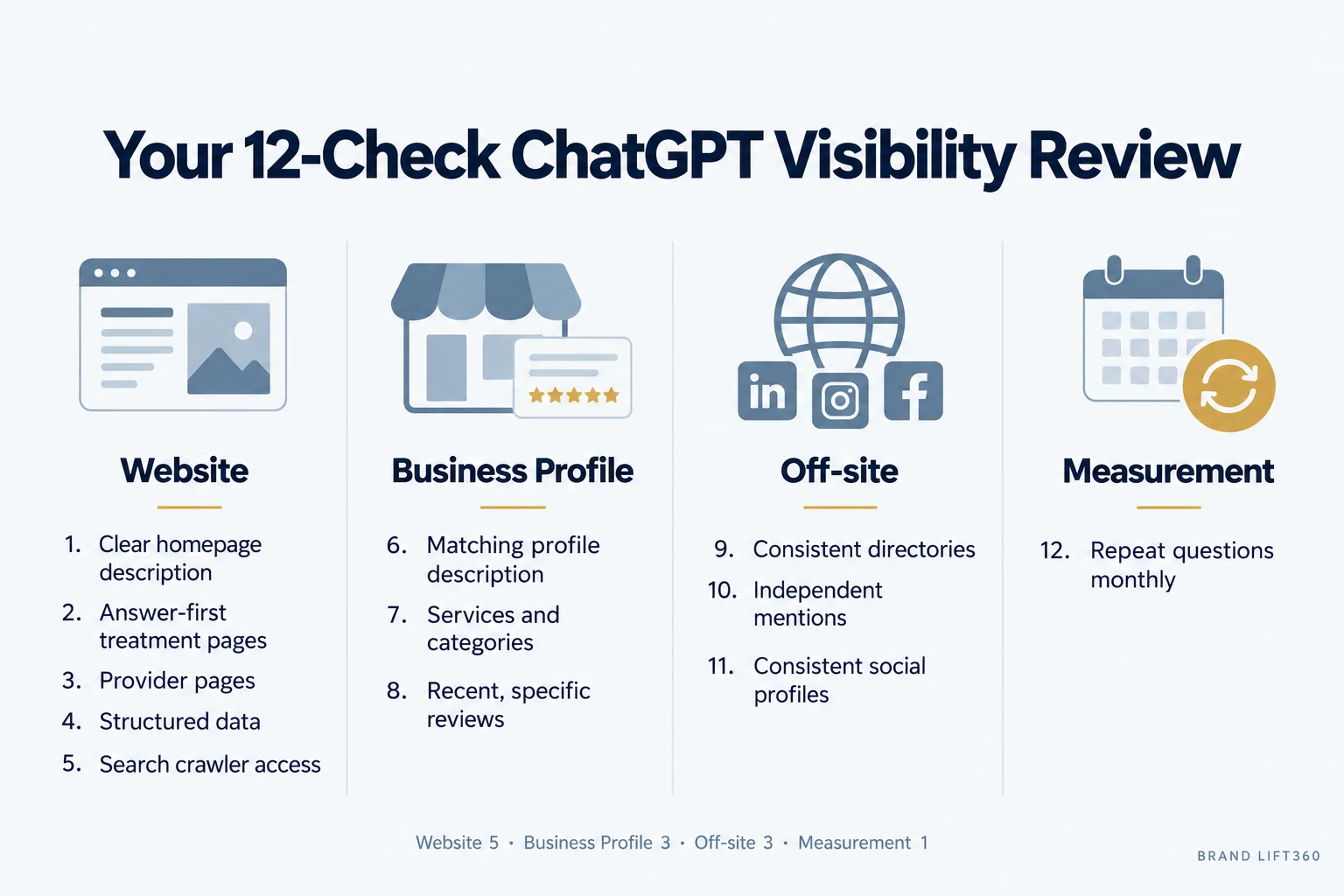
There’s no ranking list inside ChatGPT. The goal is to be named when a patient asks it for a practice like yours. ChatGPT searches the web for local questions, reads what it finds and names the practices whose facts are clearest. This 12-point checklist covers what it reads, in the order that matters, so you can work through it with your team or your marketing partner.
Brand Lift 360 does this work for medical and aesthetic practices in Roseville and Greater Sacramento as part of AI search visibility (AEO). AEO (answer engine optimization) means making your practice easy for AI assistants and Google's AI answers to find and quote. Everything below is what we do first for a new client.
Start by Checking
Before changing anything, ask ChatGPT, Gemini and Google the questions your patients ask: “best [treatment] in [city]”, “who does [procedure] near [city]”, “[specialty] near me that takes new patients.” Screenshot each answer with the date. That’s your baseline.
Your Website: 5 Checks
- Your homepage says what you are in one sentence. Specialty, city, who you serve. “[Practice] is a [specialty] practice in [city] serving [area].” Put it in the first paragraph, not in a slogan.
- Every treatment has its own page, and it answers the question first. “What is it, who is it for, what does it cost, how long is recovery, who performs it”, with the direct answer in the first two sentences under a heading that matches the question.
- Every provider has a page. Credentials, the procedures they perform, the location they work from. ChatGPT connects a named provider to a procedure and a place.
- Your pages carry structured data (also called schema). Code that labels your organization, services, providers and FAQs for machines. Yoast (a WordPress plugin for SEO, search engine optimization, the work of getting pages found in search) or a developer can add it in an afternoon.
- AI crawlers (the bots that read web pages for AI tools) aren’t blocked. Check your robots.txt file (the short text file that tells bots which pages they may read) and any firewall setting for “block AI bots.” The crawler that matters for ChatGPT answers is OAI-SearchBot. OpenAI says pages that block it won't be shown in ChatGPT search answers. GPTBot is a separate OpenAI crawler used for training its models. If OAI-SearchBot can’t read your site, ChatGPT can’t cite it.
Your Google Business Profile: 3 Checks
Your Google Business Profile is the free listing that shows your practice in Google Search and Maps.
- The description matches your homepage sentence. Same specialty, same city.
- Services and categories are complete. Each treatment you want to be known for is listed as a service.
- Reviews are recent and mention treatments. Ask every patient, following Google's tips on getting more reviews. A steady flow of reviews that name the treatment they had is stronger than a burst of five-star ratings with no text.
Off Your Site: 3 Checks
- Directories agree with you. Healthgrades, Vitals, Yelp, your professional association, the chamber of commerce. Same name, address, phone, specialty. Fix the ones that are wrong before adding new ones.
- Someone else describes you. A local news mention, a professional association profile, a guest article, a partner’s site. ChatGPT trusts facts it finds in more than one place.
- Your social profiles repeat the facts. LinkedIn, Instagram and Facebook bios use the same specialty line and link to your site.
Measuring It: 1 Check
- Repeat the same questions monthly. Same five questions, same assistants, new screenshots. Track whether you’re named, where in the list, and how you’re described. That last part matters: an assistant that calls you “a local business” instead of “a plastic surgery practice” is a sign your homepage sentence isn’t doing its job.
What This Took for Two Clients
An allergy and asthma practice became first in the captured Google AI Overview (the AI-written summary at the top of some Google results) and the first standard result for “best allergy clinic in san mateo.” A plastic surgery practice is named in Google’s AI answer for its signature body-contouring procedure. Neither needed a new website. Both needed treatment pages that answered the question, provider pages that connected the surgeon or physician to the procedure, and profiles that agreed with the site. See the case studies.
The ChatGPT Checklist at a Glance
| Where | Checks | What to confirm |
|---|---|---|
| Before you start | Baseline | Dated screenshots of ChatGPT, Gemini and Google answers to your patients' questions |
| Your website | 1 to 5 | One-sentence homepage description, one page per treatment, provider pages, structured data, AI crawlers not blocked |
| Google Business Profile | 6 to 8 | Description matches your homepage, services complete, recent reviews that name treatments |
| Off your site | 9 to 11 | Directories agree, someone else describes you, social bios repeat the facts |
| Measuring it | 12 | Same five questions monthly: are you named, where, and how are you described |
| Timing | All | Website changes can show within weeks; directory and review signals build over months |
Questions Practice Owners Ask
Can a medical practice rank in ChatGPT?
Yes, in the sense of being named. ChatGPT searches the web for local questions and names practices whose facts are clear and consistent across their website, Google Business Profile, directories and reviews.
Does ChatGPT use Google reviews?
It reads review counts, ratings and review text from the pages it finds, including Google Business Profiles and review sites, and uses them as evidence.
How long does it take?
Website changes can show up within weeks of being indexed, meaning added to Google's and other search engines' records of your pages. Directory and review signals build over months. Results vary by question, location and date, so we track with dated captures rather than promises.
What about Gemini, Perplexity and Google AI Overviews?
The same checklist applies. They read the same pages. Read LLM SEO: How AI Assistants Decide Which Practice to Recommend for how the choice gets made, and GEO vs. AEO vs. SEO for how this fits with Google.
Work the List in Order
Start with check 1 and check 5. They take the least time and they decide whether an assistant can read and classify you at all. Then fix one treatment page a week, and re-run your five questions at the end of the month. For the full website pass, including Google's new AI controls in Search Console, see AI Search Optimization for Medical Websites: 12 Fixes. If you would rather start from a finished baseline, our Practice Growth Review does the first check for you: dated screenshots from ChatGPT, Gemini and Google for your treatments and city, plus five prioritized improvements.
Sources
- OpenAI, "Overview of OpenAI Crawlers", OpenAI developer documentation, accessed October 26, 2026. Source for what OAI-SearchBot and GPTBot do and what happens when a site blocks OAI-SearchBot.
- Google Business Profile Help, "Tips to get more reviews", accessed October 26, 2026. Source for how to ask for and reply to reviews; it also bans offering discounts or gifts in exchange for reviews.
- Google Search Central, "Introduction to structured data markup in Google Search", last updated December 10, 2025. Source for what structured data does.
- Brand Lift 360 (our own data), client AI answer captures. Method: dated screenshots of Google AI Overview and AI answers for each client's target searches; client names withheld.