

The short answer
Med spa marketing works when every treatment you want to grow has its own page, its own ad group and its own rebooking interval, and when you measure booked appointments instead of clicks.
This is the 12-month plan we run for med spas in Roseville and Greater Sacramento, in the order that pays off fastest.
Brand Lift 360 is a med spa marketing agency in Roseville and Sacramento. A typical start is our Growth managed marketing plan at $1,499/month plus one ad campaign. Ad budgets start at $1,500/month per campaign, paid directly to Google or Meta, so one campaign brings the total to $2,999/month (plan and ad spend combined), and Google plus Meta brings it to $4,499/month.
A few terms used below. A CRM (customer relationship manager) is the system that logs every inquiry and its next step. SEO (search engine optimization) is the work of ranking in Google's regular results. AEO (answer engine optimization) is the work of getting named in answers from AI assistants such as ChatGPT and Google's AI Overviews, the AI-written summary at the top of some searches. Neuromodulators are wrinkle-relaxing injections such as Botox. A lead is a call or form from a potential client, not a booked visit.
Why Is Med Spa Marketing Different?
Three things set med spas apart from other practices:
- Patients search by treatment, not by spa. “Botox Roseville” and “laser hair removal near me” are the searches that book. A homepage that lists everything ranks for nothing.
- Revenue comes from the second visit. AmSpa's 2024 State of the Industry report found that 73% of med spa patients are repeat patients. Botox generally lasts three to four months and hyaluronic acid fillers about 9 to 12 months, according to the American Society of Plastic Surgeons, and laser series run over weeks. A spa that only markets for first visits leaves its biggest revenue source to chance.
- Advertising has rules. Meta requires ads for cosmetic procedures to target adults 18 and older and bans copy that puts down someone's appearance. Google restricts prescription drug terms (see Google's healthcare and medicines ad policy). Campaigns need to be built to those rules or they get rejected.
Month 1: Tracking, CRM and Ads Live
Year one does not wait on a website. The first month sets up the pieces that make every later month measurable, and gets ads running while the site is being built.
- Tracking that connects to bookings. Call tracking, form tracking and a connection to your booking system, so you know which source produced which appointment. Without this, the rest of the year is guesswork.
- The CRM and the booking path. Every inquiry gets an owner, an instant reply and a next step. Missed-call text-back (an automatic text to anyone whose call was not answered) and a two-way texting inbox keep inquiries from going to the next spa. Many leads never book, and how fast you reply is the part of that gap you control.
- Ads live around week two. For med spas that is usually Meta first: the treatments are visual and people respond to what they see. Google Ads run one campaign per treatment. In the Sacramento area, Google's Keyword Planner put the average click at about $6 for “med spa sacramento” and about $11 for “laser hair removal sacramento” over the 12 months to September 2026. A single “med spa” campaign averages everything together and hides what is working.
- Google Business Profile, complete. Every treatment listed as a service, current hours, photos of the space and team, a booking link. A search for “botox roseville” on October 26, 2026 showed the map pack (the three Google Maps listings at the top of local results) before any regular result.
Week 4 to Day 90: Site Launch and First Data
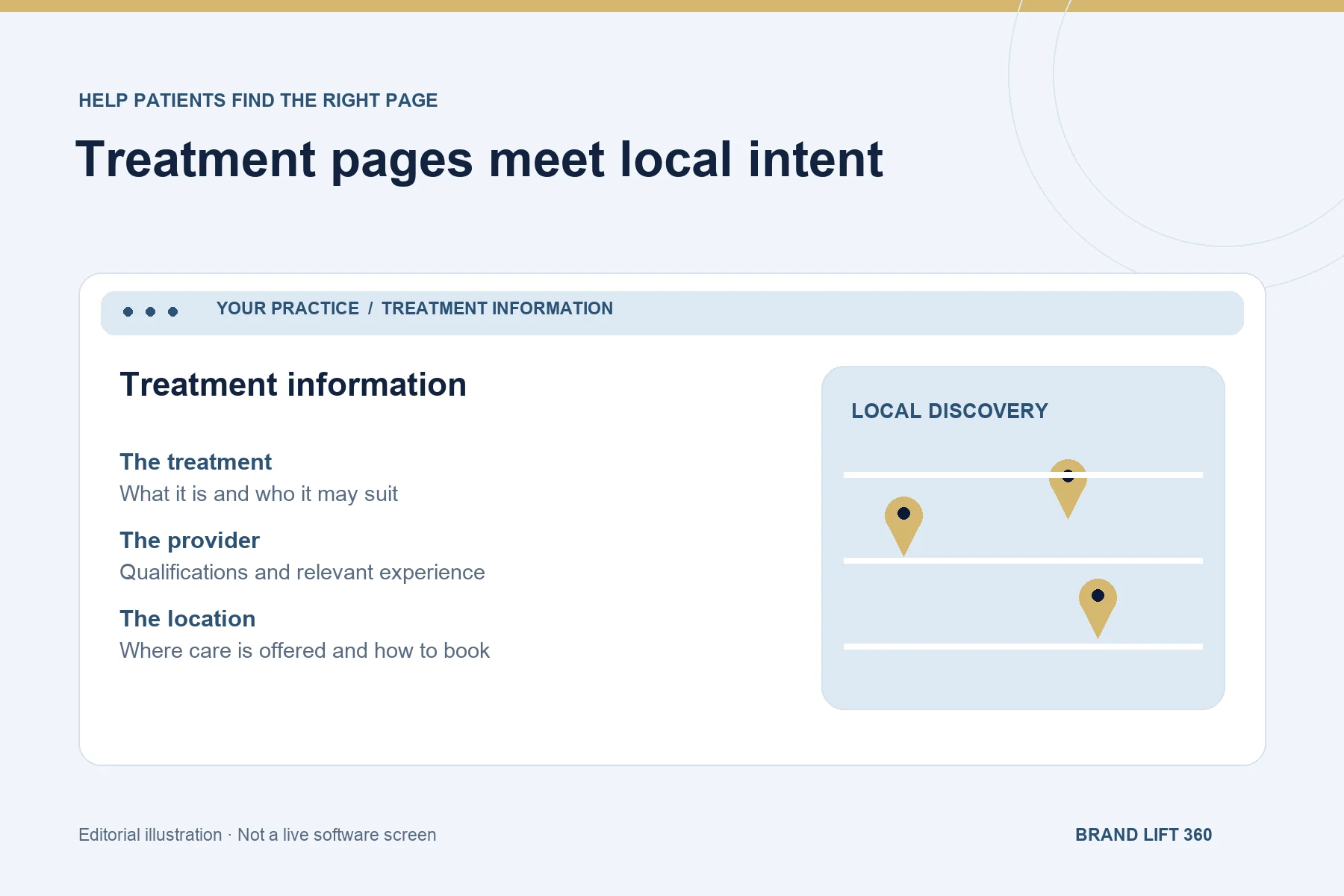
- The full site launches in week four, optimized for SEO and AEO, with one page per treatment. Start with your five highest-margin treatments. Each page answers: what it is, who it’s for, what it costs or starts at, what to expect, who performs it, and how to book. Treatment pages are what Google ranks and what AI assistants quote. Our guide to med spa SEO and ranking treatment pages locally covers what each page needs.
- A review process. A text after every eligible visit asking for an honest review. No incentives and no asking only happy clients, because Google's review policy prohibits both.
- The 90-day checkpoint. By day 90 there is real data by treatment and by source. Budget moves toward what books, and campaigns that do not book get cut or rebuilt.
Months 3–12: The Compounding Work
By month three to six every channel is in a steady cadence: local SEO and new blogs or pages every month, a steady flow of reviews, rebooking and win-back texts from the CRM, and AI search visibility checks.
- Local SEO and new content every month. New blogs or treatment pages each month, built around what patients search for, so search and AI visibility keep compounding.
- Rebooking reminders by treatment. A text at the interval your clinical team sets: 90 days for neuromodulators, longer for fillers, between sessions for laser series. Consent-based and easy to opt out of.
- Win-back and membership. A message to clients who haven’t visited in six months, and a membership offer for clients with two or more visits.
- AI search visibility. By now your treatment pages, profile and reviews give ChatGPT, Gemini and Google’s AI Overviews something to cite. We capture dated AI answers for “best med spa in [city]” and your top treatments, then fix the gaps. See how AEO works.
- Seasonal planning. Searches move by season. In Sacramento-area Google data, “laser hair removal near me” peaked in January and February 2026, and “med spa sacramento” peaked in January. Check the pattern for each of your treatments and shift ad budget a month ahead of its peak.
- Year-two budget from year-one data. By month 12 you know cost per booked appointment by treatment. Fund the treatments that book and cut the ones that don’t.
For ten ideas ranked by how fast they fill the calendar, see Med Spa Marketing Ideas That Fill the Calendar. For the software that sends rebooking and win-back texts, see Med Spa Software: Booking, CRM and Rebooking Texts.
What It Costs
There is no neutral public benchmark for what a small med spa should spend on marketing, so start from what one booked treatment is worth to you. For a 1 to 3 provider spa, a practical starting point is a managed marketing plan from $1,499/month plus ad budgets from $1,500/month per campaign, paid directly to Google or Meta with no markup. Read Med Spa Advertising: Google vs. Meta, and What Each Costs for the ad budget breakdown.
What to Measure
| Measure | Why |
|---|---|
| Inquiries by source | Which channel starts the conversation |
| Booked appointments by treatment | Which treatments the marketing actually sells |
| Attended appointments | A booking that no-shows isn’t revenue |
| Cost per booked appointment | The number that decides next month’s budget |
| Rebooking rate | Repeat patients are most med spa patients |
Report leads and booked appointments separately. A lead is not a patient.
The 12-Month Plan at a Glance
| When | What happens | What it gives you |
|---|---|---|
| Month 1 | Tracking, CRM and booking path; ads live around week two; Google Business Profile complete | Every inquiry tied to a source |
| Week 4 | Full site with one page per treatment, starting with your five highest-margin treatments | Pages Google ranks and AI assistants quote |
| Day 90 | Checkpoint by treatment and source | Budget moves to what books |
| Months 3 to 12 | Monthly content, reviews, rebooking and win-back texts, AI visibility checks, seasonal budget shifts | Repeat visits and steady new inquiries |
| Month 12 | Cost per booked appointment by treatment | A year-two budget built on your own data |
| Cost | Growth plan $1,499/month plus ad budgets from $1,500/month per campaign, paid directly to Google or Meta: $2,999/month in total with one campaign, $4,499/month with Google and Meta | |
Questions Med Spa Owners Ask
How much should a med spa spend on marketing?
Start from what one booked treatment is worth, not from an industry percentage. For a 1 to 3 provider spa, a managed marketing plan plus $1,500/month in ads is a practical start; scale the ad budget as booked appointments prove out.
What’s the most important channel?
Your Google Business Profile and treatment pages, because most searches name a treatment and a place. Ads add volume on top of that foundation.
Do you take more than one med spa in an area?
No. One med spa per agreed area. See plans and pricing.
Start With Your Baseline
Before month one, write down three numbers for your top two treatments: inquiries last month, booked appointments, and attended appointments. That is the baseline every later month is measured against. Then search each treatment with your city in Google and ChatGPT and note who gets named. Our free AI Visibility Audit does that second check for you.
Sources
- 2024 Medical Spa State of the Industry Executive Report Recap, American Med Spa Association (AmSpa), November 6, 2024.
- How long does Botox last?, American Society of Plastic Surgeons, November 12, 2019.
- Taking the mystery out of Botox and dermal fillers, American Society of Plastic Surgeons, October 4, 2019.
- Healthcare and medicines, Google Advertising Policies Help, accessed October 2026.
- Health and Wellness ad standards, Meta Transparency Center, updated July 22, 2026.
- Prohibited and restricted content (review incentives and selective solicitation), Google Maps user-generated content policy, accessed October 2026.
- Google Ads Keyword Planner data and a Google results page for “botox roseville” (Roseville, CA), both retrieved through DataForSEO on October 26, 2026; search volumes and average cost per click cover the 12 months to September 2026.
- Brand Lift 360 (our data): the month-by-month sequence and the week-two ad start come from the med spa accounts we manage. Method: we compare inquiries and booked appointments by treatment and platform at each account's 90-day review.